

Introduction
Buying your second home feels strange in a specific way. The paperwork looks familiar, the vocabulary feels comfortable, but something's off. Rates have moved. Your income has changed. And this time, there's no first-time buyer safety net to lean on.
Repeat buyers now make up nearly 60% of purchases nationally, per the National Association of Realtors.
Second-time buyers face a unique set of headaches: no down payment perks, no beginner's grace period, and often the added complexity of selling one home while buying another. In the Bay Area, where inventory shifts fast and pricing swings by neighborhood, that complexity multiplies.
This guide breaks down what's actually changed since your last purchase, how financing rules differ for repeat buyers, and how to handle the buy-before-sell dilemma without losing your footing (or your dream house).
Key Takeaways
- Repeat buyers often need bigger down payments, but equity usually covers the gap
- You may requalify as a first-time buyer after three-plus years without homeownership
- Carrying two mortgages raises your debt-to-income ratio and can complicate approval
- Bridge loans close the timing gap between selling and buying your next home
- Bay Area inventory growth since 2024 gives repeat buyers more room to negotiate
What Is a Second-Time Home Buyer?
A second-time home buyer is anyone who previously owned a primary residence and is now purchasing another one. This broad category covers buyers who are upsizing for a growing family, downsizing after the kids move out, relocating for work, or buying an investment property. You don't need to have sold your last home—just to have held title to one before.
Many buyers don't realize this: you can sometimes qualify as a "first-time buyer" again, even with a home purchase already behind you.
Under HUD guidelines, you may still count as a first-time buyer if:
- You haven't held ownership interest in a principal residence during the three years before your new purchase
- You're a displaced homemaker who only owned a home jointly with a former spouse
- You're a single parent who only owned property with a former spouse during marriage
- Your prior home wasn't permanently affixed to a foundation, or it violated local building codes beyond reasonable repair
This classification matters more than it sounds. It can unlock down payment assistance, closing cost grants, and tax credit programs that repeat buyers typically can't access. If it's been a few years since you sold your last house, it's worth checking before assuming you don't qualify.
First-Time vs. Second-Time Buying: What Has Changed
The mechanics of buying a home haven't changed much. Everything around them has.
Market and Timing Differences
Real estate cycles don't stand still, and the Bay Area is proof. Unsold inventory across the region hit 2.9 months in May 2025, up from just 1.9 months in May 2024. Homes also lingered longer, with median time on market climbing to 16 days, compared to 12 days the year before, according to California Association of Realtors data.
That's not a dramatic shift toward a buyer's market, but it does mean less frantic bidding and slightly more breathing room than the frenzy of a few years back.
Underwriting and Debt-to-Income Differences
If it's been ten-plus years since your last mortgage, expect more paperwork, not less. Lenders now typically require:
- A pay stub dated within 30 days of your application
- W-2s covering the most recent one to two years
- Income documented as stable, predictable, and likely to continue
Credit score rules have also evolved. Manually underwritten conventional loans generally require a minimum score of 620 for fixed-rate mortgages and 640 for adjustable-rate loans, though automated underwriting systems now weigh a fuller risk picture rather than a single cutoff.
Debt-to-income calculations add another layer of complexity for move-up buyers. If you're buying before your current home sells, lenders generally must count both mortgages, principal, interest, taxes, insurance, and any association dues, when calculating your DTI ratio.
The only workaround: your lender can exclude your current home's payment if you have an executed sales contract with all financing contingencies cleared. Without that, two mortgages on paper can push your DTI past what many programs allow. This is exactly the gap bridge financing is built to close, letting move-up buyers make a non-contingent offer without carrying two mortgages at once.
Advantages Second-Time Buyers Bring
It's not all obstacles. Second-time buyers usually walk in with real advantages:
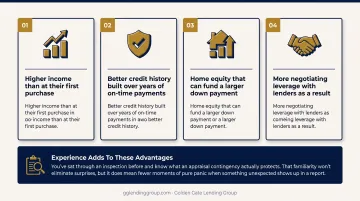
- Higher income than at their first purchase
- Better credit history built over years of on-time payments
- Home equity that can fund a larger down payment
- More negotiating leverage with lenders as a result
Experience adds to these advantages. You've sat through an inspection before and know what an appraisal contingency actually protects. That familiarity won't eliminate surprises, but it does mean fewer moments of pure panic when something unexpected shows up in a report.
Down Payments, LTV & Loan Options for Second-Time Buyers
Repeat buyers rarely get the lowest down payment options available to first-timers, but they usually don't need them either.
Here's how minimum down payments generally compare:
| Loan Type | Typical Minimum Down Payment | Notes |
|---|---|---|
| Conventional | 5% | First-time buyers may qualify for 3% under certain programs |
| FHA | 3.5% | Requires a 580+ credit score for max financing |
| VA | 0% | Available to eligible veterans with full entitlement |
| Jumbo | Varies by lender | Often requires more equity than conventional loans |
Loan-to-value limits follow a similar pattern. Freddie Mac permits up to 95% LTV on standard one-unit primary residence purchases, while Fannie Mae's 97% LTV option is generally reserved for buyers with at least one first-time purchaser on the loan.
Jumbo LTV limits are lender-specific and typically run lower than conventional caps. Confirming exact terms with your lender matters before you start house hunting.
Beyond loan terms, where does the down payment actually come from? For most repeat buyers, it's home equity. According to NAR's 2025 buyer profile, 54% of repeat buyers used proceeds from their previous home sale to fund the next purchase, with median down payments reaching 23%, more than double the first-time buyer median.
Your available equity is your sale price, minus your remaining mortgage balance, minus closing costs. That number determines what you can put down before your next loan even enters the picture.
Loan Options to Consider
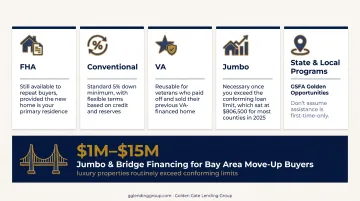
- FHA: Still available to repeat buyers, provided the new home is your primary residence
- Conventional: Standard 5% down minimum, with flexible terms based on credit and reserves
- VA: Reusable for veterans who paid off and sold their previous VA-financed home
- Jumbo: Necessary once you exceed the conforming loan limit, which sat at $806,500 for most counties in 2025 (higher in designated high-cost areas)
- State/local programs: Some, like GSFA Golden Opportunities, explicitly welcome repeat buyers. Don't assume assistance is first-time-only. Check HUD.gov or your local housing agency directly
Jumbo territory is common in the Bay Area, where luxury properties routinely exceed conforming limits. That's exactly where Golden Gate Lending Group structures its jumbo and bridge financing, typically from $1 million to $15 million, for move-up buyers targeting higher-value neighborhoods where standard loan limits fall short.
Buy Before You Sell, or Sell Before You Buy?
This is the question that keeps second-time buyers up at night. There's no universally right answer, but there is a right answer for your specific situation.
Most buyers default to selling first because it feels safer. In a competitive market, though, that safety can cost you the home you actually want.
Selling First: Pros and Cons
Advantages:
- Access to full equity without a home-sale contingency
- No dual mortgages weighing down your DTI (debt-to-income ratio)
- Room to negotiate your purchase from a position of strength
Drawbacks:
- Temporary housing between closings
- Double moving costs and logistics
- Risk of buying into a market that's shifted while you waited
Buying First: Pros and Cons
Advantages:
- No temporary housing gap
- Freedom to act fast when the right home appears
- More time to prepare and stage your current home before listing
Drawbacks:
- Carrying two mortgages simultaneously
- Elevated DTI that can complicate qualification
- Ongoing costs, property tax and insurance, on both properties at once
The Bridge Loan Solution
This is where bridge financing earns its reputation. A bridge loan unlocks the equity already sitting in your current home, letting you fund a new purchase before your existing property sells. Instead of submitting a contingent offer that sellers can (and often do) pass over, you're able to compete like a cash buyer.
This matters most in neighborhoods where sellers have their pick of offers and simply favor the cleanest one. Golden Gate Lending Group, the #1-ranked Consumer Bridge Lender in California according to Scotsman Guide, specializes in exactly this scenario: owner-occupied bridge financing for homeowners who need to move without waiting on a sale.
One approach the firm has structured involves working directly with a buyer's real estate agent. Together, they set a realistic timeline for selling the existing property while bridge funds cover the new purchase in the meantime.
Bridge loans aren't free money, though. They carry short-term costs and require a genuine exit strategy, meaning your current home needs to sell within a reasonable window. Working with a lender who structures these deals regularly, rather than occasionally, makes a real difference in how smoothly that exit plays out.

Tips for a Smooth Second-Time Home Purchase
A few habits separate buyers who close without drama from those who don't.
Get fully pre-approved, not just pre-qualified. A pre-approval carries real underwriting weight, and bridge lenders like Golden Gate Lending Group can issue one in under five minutes, based on equity rather than income. In competitive Bay Area offers, it signals you're serious and financially vetted, not just window shopping.
Work with an agent experienced in dual transactions. Coordinating a sale and purchase at once takes someone who's done it before and can manage overlapping timelines without dropping the ball.
Limit contingencies where you can afford to. Fewer contingencies make your offer more attractive, but don't skip the home inspection. Schedule it early, even in a fast-moving deal, so surprises show up before closing, not after.
Frequently Asked Questions
What is a second-time home buyer?
Anyone who previously owned a primary residence and is purchasing another, whether they're upsizing, downsizing, relocating, or buying an investment property. Prior ownership is the only requirement.
How much deposit do you need as a second-time home buyer?
Conventional loans typically require at least 5% down, FHA requires 3.5%, and eligible VA borrowers can put down 0%. Jumbo loans, common in higher-priced markets, often require more.
Do I need to sell my current home before buying a new one?
Not necessarily. Bridge loan programs, like Golden Gate Lending Group's Buy Before You Sell option, let you tap into your existing home's equity to make a non-contingent offer before your current property sells.
Can you be a first-time home buyer twice?
Yes, under HUD guidelines. If you haven't owned a home in the past three years, or meet certain exceptions like divorce or a non-conforming prior property, you may still qualify for first-time buyer programs.
Is it harder to qualify for a mortgage the second time around?
Credit standards may be stricter than years ago, but an improved income, stronger credit history, and built-up equity often make qualifying easier for repeat buyers than it was the first time.
Can second-time buyers still use FHA or VA loans?
Yes. Both remain available to repeat buyers, and VA benefits are reusable once a prior VA loan is paid off, as long as the new home will serve as your primary residence.