

Introduction
Walk through Pacific Heights, Noe Valley, or Cow Hollow on a Saturday during an open house, and you'll see it: a line of buyers, agents comparing notes, and a seller who knows they hold the cards.
There, homes are selling for roughly 15% over list price in about two weeks, with hot properties moving even faster.
In markets like these, a non-contingent offer can be the difference between winning and losing a home. But it comes at a cost: buyers give up standard protections the moment they sign.
This guide breaks down what a non-contingent offer actually means, how it compares to a contingent one, and how to make one without putting your finances at unnecessary risk.
Key Takeaways
- A non-contingent offer waives your exit rights, not your legal protections against fraud or misrepresentation
- Only 12% of buyers waived inspection contingencies; 15% waived appraisal contingencies as of January 2026
- Earnest money, capped near 3% of price under California law, is at risk if you cancel without a valid contingency
- Bridge financing can remove the riskiest contingency (home sale) without forcing you to waive others
What Is a Non-Contingent Offer?
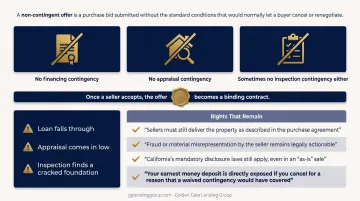
A non-contingent offer is a purchase bid submitted without the standard conditions that would normally let a buyer cancel or renegotiate. No financing contingency. No appraisal contingency. Sometimes no inspection contingency either.
Once a seller accepts, the offer becomes a binding contract. There's no built-in exit ramp if your loan falls through, the appraisal comes in low, or the inspection turns up a cracked foundation.
That said, "non-contingent" doesn't mean you've signed away every right you have.
- Sellers must still deliver the property as described in the purchase agreement
- Fraud or material misrepresentation by the seller remains legally actionable
- California's mandatory disclosure laws still apply, even in an "as-is" sale
- Your earnest money deposit is directly exposed if you cancel for a reason that a waived contingency would have covered
How Common Is Waiving Contingencies, Really?
Despite the pressure buyers feel in hot neighborhoods, waiving protections is still the minority approach nationally. According to NAR's Realtors Confidence Index for January 2026, only 12% of buyers waived their inspection contingency and 15% waived their appraisal contingency — both data-series lows.
In other words: most buyers, even in competitive markets, keep at least some protections in place. A non-contingent offer is a strategic tool, not the default play.
For buyers who want that negotiating edge without unlimited risk, bridge financing offers a middle path — using home equity to remove the financing contingency safely, without waiving other protections.
Contingent vs. Non-Contingent Offers: What's the Difference?
A contingent offer includes conditions that must be satisfied before the sale closes. If a condition isn't met, the buyer can typically cancel and get their deposit back.
The most common contingencies cover:
- Financing (can the buyer actually get the loan?)
- Appraisal (does the home value support the price?)
- Inspection (are there hidden defects?)
- Home sale (has the buyer's current property sold?)
A non-contingent offer strips these conditions out, shifting the risk from seller to buyer in exchange for a stronger, more certain bid. Bridge financing addresses this trade-off directly: accessing equity from your current home before it sells lets you submit a non-contingent offer. This is the strategy behind Golden Gate Lending Group's Buy Before You Sell Program.
Here's how the two stack up side by side:
| Factor | Contingent Offer | Non-Contingent Offer |
|---|---|---|
| Buyer protection | High: multiple exit points | Low: few or no exit points |
| Closing certainty | Lower, depends on conditions clearing | Higher, in principle |
| Seller risk exposure | Higher: deal can fall through | Lower: fewer cancellation paths |
| Competitive appeal | Standard | Stronger in multiple-offer situations |
One caveat: even non-contingent offers still depend on the buyer actually being able to close. If financing falls apart without a contingency to fall back on, the deal doesn't become risk-free for the seller. It just shifts the fallout to a default scenario instead of a clean cancellation.
Common Contingencies Buyers Choose to Waive
Not every contingency carries the same weight. Buyers typically consider waiving these, roughly in order of how often it happens:
- Appraisal contingency — protects against the home appraising below the purchase price. Waived by 15% of buyers as of early 2026.
- Inspection contingency — allows cancellation based on property condition findings. Waived by 12% of buyers.
- Financing contingency — gives buyers a window (often 21 days under C.A.R. guidelines) to secure a loan. Less commonly waived outright since so much rides on it.
- Home sale contingency — ties the purchase to selling the buyer's existing home first.
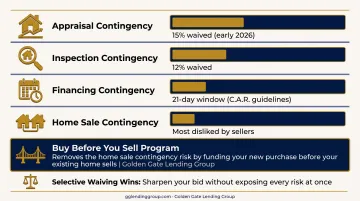
Sellers dislike the home sale contingency most, and for good reason: it makes the entire deal dependent on a second, separate transaction closing on time. If that home sale stalls, so does the purchase. Bridge financing, like Golden Gate Lending Group's Buy Before You Sell Program, removes this risk by funding the new purchase before the existing home sells.
Waiving contingencies isn't all-or-nothing. A buyer can waive the appraisal contingency to sharpen their bid while keeping the inspection contingency for peace of mind. This selective approach is often smarter than going fully non-contingent — you get some competitive edge without exposing yourself to every possible risk at once.
Benefits and Risks of Going Non-Contingent
Why Sellers and Buyers Both Consider Non-Contingent Offers
Sellers gravitate toward non-contingent offers because they cut down on the chance a deal collapses mid-escrow. Fewer contingencies means fewer reasons for a buyer to walk away, and that translates into a shorter, more predictable path to closing.
For buyers, the calculation is different but the logic still holds up. In a multiple-offer situation, a non-contingent bid signals seriousness. It tells the seller: this buyer isn't going to renegotiate after inspection or ask for a price cut if the appraisal comes in light.
There's a practical upside too — negotiations move faster without contingency-related back-and-forth. No haggling over repair credits. No waiting on an appraiser's schedule to see if the deal survives.
What Buyers Risk When They Waive Protections
The trade-off is real, and it shows up in four places:
- Earnest money exposure. If you cancel for a reason a waived contingency would have covered, you can lose your deposit. California's liquidated damages statute caps this at roughly 3% of purchase price for qualifying transactions, but on a $2M home, that's still $60,000.
- Appraisal gap risk. If the home appraises below your offer, you must cover the difference in cash. This isn't rare: FHFA data shows below-contract appraisals occurred in 15% of transactions in 2021 and 12% in 2022, up from a 7-9% baseline in prior years.
- Inspection risk. Skip the inspection contingency, and you inherit whatever's wrong with the property after closing. No renegotiating. No walking away.
- Home sale strain. Waive the home sale contingency without a plan, and you could end up covering two mortgages simultaneously if your current home takes longer to sell than expected.
That last risk catches buyers off guard most, but it has the most straightforward fix: bridge financing. Golden Gate Lending Group's Buy Before You Sell program lets homeowners tap their current equity to fund a non-contingent purchase, so you're never stuck carrying two mortgages while waiting for your old home to sell.
How to Make a Strong, Well-Protected Non-Contingent Offer
Going non-contingent doesn't have to mean going in blind. A few concrete steps separate a reckless offer from a calculated one:
- Get fully underwritten, not just pre-approved. The CFPB confirms that neither prequalification nor preapproval guarantees a loan. Before waiving a financing contingency, confirm exactly what conditions remain on your file, not just a lender's phone estimate.
- Do your due diligence before waiving inspection. Review seller disclosures closely and, where allowed, schedule a pre-inspection before submitting your offer. This gives you the insight an inspection contingency would provide, minus the right to cancel.
- Work with a local team who knows the comps. An agent and lender familiar with recent sales in Pacific Heights or Noe Valley will help you avoid appraisal-gap surprises tied to overpaying in a hot micro-market.
- Solve the home sale contingency with bridge financing, not luck. Instead of racing to sell your current home first or juggling two mortgages at once, an owner-occupied bridge loan taps your existing home equity to fund the new purchase.
- Back it up with a real deposit. A substantial earnest money deposit signals genuine commitment, giving sellers real confidence beyond the numbers on paper.
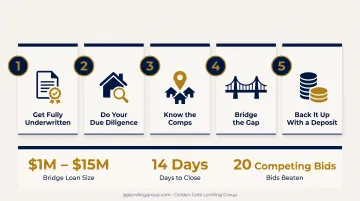
Golden Gate Lending Group structures these bridge loans between $1M and $15M, sized around the equity already in your current property rather than income documentation. One client used this approach to close a non-contingent, cash-like offer in 14 days, beating out 20 competing bids without needing cash sitting in the bank.
Frequently Asked Questions
What is the difference between contingent and non-contingent offers?
A contingent offer includes conditions, like financing, inspection, or appraisal, that protect the buyer and allow cancellation if unmet. A non-contingent offer removes those protections in exchange for a stronger, faster bid.
Do sellers dislike contingent offers?
Sellers generally prefer non-contingent offers because they reduce uncertainty and speed up closing. That said, contingent offers remain common and are still accepted, particularly outside the hottest seller's markets.
Can a buyer get out of a contingent offer?
Yes. A buyer can cancel a contingent offer if a specified condition, such as financing, inspection, or appraisal, isn't satisfied within the contingency period, and typically keeps their earnest money deposit.
Can you waive only some contingencies instead of all of them?
Yes. Buyers can selectively waive certain contingencies, like appraisal, while keeping others, like inspection, to balance competitiveness with protection.
Is 10% off a lowball offer?
It depends. Whether 10% under asking counts as a lowball offer hinges on local market conditions, days on market, and comparable sales, not on whether the offer is contingent or non-contingent.