

This decision shapes your budget, your negotiating leverage, and your exposure to risk. 54% of repeat buyers used proceeds from their previous home's sale to fund their next purchase, according to NAR's 2025 Profile of Home Buyers and Sellers — proof that sale equity is often the real constraint, not preference.
The right answer depends on your cash reserves, local market conditions, and risk tolerance. Financing tools like bridge loans can change the entire calculation, which is exactly what we'll unpack below.
Key Takeaways
- Selling first protects your budget but may require temporary renting
- Buying first skips the move-out scramble but usually requires bridge financing
- Debt-to-income ratio and market conditions largely drive this decision
- Bridge loans and rent-back deals ease the transition either way
- There's no universal answer — only what fits your finances and timeline
Sell First vs. Buy First: Quick Comparison
Neither path is automatically smarter. Each shifts risk to a different part of the transaction. Here's how they stack up side by side:
| Factor | Sell First | Buy First |
|---|---|---|
| Financial risk | Lower — no overlapping mortgages | Higher — may carry two payments temporarily |
| Negotiating power | Strong, non-contingent offers backed by sale proceeds | Often needs a home-sale contingency, which can weaken offers |
| Housing gap | May require temporary housing or storage | Move directly into the new home |
| Financing complexity | Simple — one mortgage at a time | May require a bridge loan, HELOC, or cash-out refinance |
| Best market fit | Slower or buyer-favorable markets | Fast seller's markets or urgent relocations |
Quick guidance for choosing your path:
- Sell first when minimizing financial risk matters more than timing certainty
- Buy first when you've found the right home and need a stronger, non-contingent offer
- Bridge financing, like Golden Gate Lending Group's Buy Before You Sell Program, unlocks equity from your current home so you can make a cash-backed offer without carrying two mortgages
Offer strength matters more than most sellers admit. In a roughly 9,000-offer study, Redfin found that waiving a financing contingency increased the odds of winning a bidding war by 20%, while an all-cash offer boosted it by 206%. Contingent offers, including home-sale contingencies, simply carry less weight when a seller has other options on the table.

Selling Your House Before Buying: Pros, Cons & Best Fit
Selling first means you know your exact budget before you make an offer on anything. There's no guesswork about financing, and no risk of holding two mortgages at once.
The pros:
- Stronger negotiating power as a buyer since your offer isn't contingent on another sale
- Immediate access to home equity for your next down payment
- No dual-mortgage strain on your monthly budget
The cons:
- Possible gap in housing if your next home isn't ready
- Pressure to find and close on a new place quickly
- Risk of missing out on a desired property while renting in the interim
A few tactics reduce that risk considerably. A rent-back agreement lets you stay in your sold home for a set period, typically 30 to 60 days, according to Redfin, while you shop for the next one. Extending the closing date or using short-term storage between moves can also buy breathing room without derailing your timeline.
Who Should Sell First
- Homeowners without significant cash reserves, or who wouldn't qualify for a second mortgage under current debt-to-income requirements
- Sellers in a slower or buyer-favorable market where homes may sit longer before going under contract
- Buyers willing to rent temporarily in order to avoid bridge loan interest and fees altogether
Buying Your New House Before Selling: Pros, Cons & Best Fit
Buying first lets you secure your next home without a rushed, high-pressure move — a real advantage in competitive markets where good listings disappear fast.
The pros:
- No frantic move-out timeline forcing a rushed decision
- More time to shop for the right property instead of settling
- You skip the cost and hassle of temporary housing
The cons:
- Risk of carrying two mortgages if your current home takes time to sell
- Tougher loan qualification, since your debt-to-income ratio now includes both properties
- Added pressure to sell quickly once you've relocated
This is where bridge financing changes the math. A bridge loan or cash-out refinance can unlock equity in your current home before it sells, giving you funds for a down payment and letting you submit a non-contingent offer.
That matters most in luxury markets. San Francisco luxury home sales climbed 22.2% year over year in March 2026, with a median contract time of just 12 days and 62.4% of listings going under contract within two weeks, per Redfin's luxury market report. At that pace, sellers gravitate toward buyers who can close without waiting on another sale.
Golden Gate Lending Group fills exactly this gap for Bay Area buyers. The firm structures owner-occupied bridge loans specifically for Bay Area buyers who need to move on a home before their current one sells, using existing equity so buyers can compete with cash-like offers instead of waiting on a chain of contingencies.

Who Should Buy First
- Buyers relocating for work, competing in a hot seller's market, or who found their ideal home before their current one sold
- Homeowners with substantial equity who can qualify for bridge financing
- Move-up buyers who want certainty about their next home before listing their current one
Which Option Is Right for You? A Decision Framework
Before committing to either path, work through these questions honestly:
- Can I afford two mortgages temporarily if my current home takes longer to sell than expected?
- Do I qualify for a second loan given my current debt-to-income ratio and documented income?
- Is my local market a buyer's or seller's market right now, and how fast are comparable homes moving?
- How much equity do I have, and would it support bridge financing if needed?
- How flexible is my timeline — do I have a hard move-out date, or room to negotiate?
Your risk tolerance and cash reserves should guide the answer more than general advice. Buyers with strong equity and reserves have far more flexibility to buy first without exposing themselves to financial strain.
Coordination matters too. A real estate agent and lender working together can align closing dates so you move only once, avoiding the double-move scenario that makes buy-first feel risky in the first place.
With those logistics sorted, the final step is getting pre-approved and talking through bridge loan options with a lender. Golden Gate Lending Group, for instance, offers equity-based pre-approval in under five minutes, so financing constraints don't have to be the reason you rule out a strategy before exploring it. There's no universal "better" choice here, just the strategy that matches your finances, your timeline, and the market you're actually in.
Real-World Scenario: Bridging the Gap Between Two Homes
Picture a common Bay Area situation: a homeowner finds their next home in a sought-after neighborhood, the kind of listing that goes under contract within two weeks. Their current home hasn't sold yet, and most of their net worth is tied up in its equity.
The challenge: making a strong, non-contingent offer without liquid cash for a down payment. A contingent offer in that market risks losing to a buyer who doesn't need one.
The solution: an owner-occupied bridge loan structured against the equity in the current home. Golden Gate Lending Group has closed transactions like this in as few as 14 days with no contingencies attached — a stark contrast to the 30-60 day timelines typical of home-sale contingency periods.
In one documented case, the firm approved a $2.7 million bridge loan and closed within five days after a conventional lender had already stalled the borrower for months.
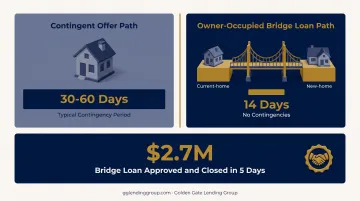
The takeaway: when structured correctly, bridge financing turns "buy first" from a gamble into a calculated strategy. It removes the dependency on a perfectly timed sale and lets buyers compete on equal footing with cash offers.
If you're weighing this route in the Bay Area, talk with Golden Gate Lending Group about tailored bridge loan solutions before you submit an offer on your next home.
Frequently Asked Questions
What to do first when buying and selling a house?
Get pre-approved and talk to a real estate agent or lender before listing or making offers. This gives you a clear read on your finances and local market conditions before you commit to either move.
What happens if I sell my house and don't buy another one?
Sale proceeds are typically held in escrow or your bank account until you're ready to purchase. Many sellers rent temporarily or stay with family while they shop for their next home.
What is the hardest month to sell a home?
Winter months, particularly January, tend to see the slowest sales activity nationally. Local conditions vary, so check current seasonal data for your specific Bay Area market before assuming this applies to you.
Can you close on a new house before selling your current one?
Yes, this is often achieved through bridge loans or cash reserves. Golden Gate Lending Group structures these short-term loans for exactly this scenario, though you'll still need a plan to carry both properties if your sale takes longer than expected.
How does a home sale contingency affect my offer in a competitive market?
Contingent offers are generally less attractive to sellers in hot markets since they introduce uncertainty. Pairing one with a larger earnest money deposit or flexible closing terms can help offset that disadvantage.
Is a bridge loan a good option for buying before selling?
Bridge loans work well for qualified buyers with substantial equity, especially in competitive or luxury markets where speed matters. Golden Gate Lending Group's equity-based approval, often completed in under five minutes, makes them a strong option, though they carry higher rates and shorter terms than traditional mortgages.