
This is cross-collateralization, and it's a term many Bay Area buyers encounter mid-transaction without ever having heard it before. It sounds technical, but the concept is straightforward once you break it down.
This article explains what cross-collateralization means, how it actually works, the benefits and risks involved, and why it shows up so often in luxury real estate and bridge financing across San Francisco and the greater Bay Area.
Key Takeaways
- Cross-collateralization uses shared assets to secure multiple loans, raising borrower risk
- Dragnet clauses let lenders claim your collateral for other debts owed to them
- Bridge loans in competitive markets like San Francisco often rely on this structure
- Defaulting on one linked loan can put every cross-collateralized asset at risk
- Getting out usually means full repayment, renegotiation, or a careful refinance
What Is Cross-Collateralization?
Understanding Collateral: The Basics
Collateral is an asset you pledge to guarantee repayment of a loan. If you stop paying, the lender can seize that asset to recover its losses. Common examples include:
- Real estate (homes, investment properties)
- Vehicles
- Cash deposits or savings accounts
- Business equipment or inventory
The Consumer Financial Protection Bureau explains that secured loans are backed by collateral, while unsecured loans are not, and that distinction matters for pricing. Because unsecured lending carries more risk for the lender, it often comes with a higher interest rate. Secured loans, backed by something tangible, tend to give lenders more comfort and borrowers more negotiating room.
Defining Cross-Collateralization
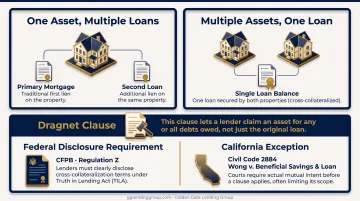
Cross-collateralization takes the basic idea of collateral one step further. It happens in one of two ways:
- One asset secures multiple loans: your home backs both your primary mortgage and a second loan.
- Multiple assets secure a single loan: two properties, for example, both stand behind one loan balance.
The loans involved don't need to match. A car could secure both an auto loan and an unrelated personal loan, as long as the lender structures the agreement that way.
Most of these arrangements include what's called a dragnet clause: legal language that lets a lender claim an asset as collateral for any or all debts you owe them, not just the original loan.
Federal rules require lenders to disclose this. Per CFPB commentary on Regulation Z, using collateral from an existing loan to secure a new obligation counts as a security interest that must be disclosed to the borrower, though the required language can vary by transaction type.
However, California doesn't treat dragnet clauses as automatic. Under Civil Code 2884, contractual liens can secure future obligations, but California courts (see Wong v. Beneficial Savings & Loan) have ruled that both parties must have actually intended the clause to cover the debt in question. A broadly worded clause doesn't automatically sweep in everything you owe.
How Cross-Collateralization Works
The mechanics are simpler than the terminology suggests. When you take out a second loan, the lender extends its security interest to include collateral you already pledged elsewhere, creating shared exposure across both obligations.
The Classic Example: A Second Mortgage or HELOC
If you've built equity in your home through your first mortgage, a lender may let you tap that equity to secure a second loan or line of credit. The home now backs two separate debts instead of one.
The reverse also happens. A blanket mortgage uses multiple properties to secure a single loan, common among real estate investors managing multi-unit portfolios.
Instead of separate loans on each building, one loan covers them all, often with a release clause allowing individual properties to be sold off over time.
| Structure | Debt-to-Collateral Relationship | What Happens on Sale/Default |
|---|---|---|
| Single-property loan | One debt, one property | Payoff clears the lien |
| Blanket mortgage | One debt, multiple properties | Sale depends on release clause terms |
| Cross-collateralized loan | Multiple debts, shared collateral | Lender may hold liens until all obligations are satisfied |
LTV Ratios and Cross-Default Risk
Lenders watch loan-to-value (LTV) ratios closely in these arrangements, since more debt against the same collateral pool means more exposure. In residential bridge lending, published LTV limits tend to sit in a fairly consistent range.
Rocket Mortgage lists a maximum 80% LTV/CLTV/HCLTV on its bridge loan product, while Herring Bank's guidance points to a typical 70%-80% range calculated against the existing home's appraised value minus the outstanding mortgage balance. These figures reflect lender-specific policies rather than a universal regulatory ceiling, but they offer a realistic benchmark.
Then there's cross-default risk. Because the same asset secures multiple obligations, missing a payment on one loan can trigger default on every linked loan — even if you're current on the others. This is the single biggest thing borrowers underestimate about cross-collateralized structures.
Benefits and Risks of Cross-Collateralization
Benefits
Structured correctly, cross-collateralization can create real advantages for borrowers.
- Increased borrowing capacity — leveraging existing equity often unlocks a larger loan amount than a single-asset loan would support
- Potentially better terms — added security can sometimes translate into more favorable rates, though this isn't guaranteed and depends heavily on the lender
- Faster, simpler closings — fewer assets to appraise means quicker approvals, critical in fast-moving luxury markets where timing wins deals
Risks
The tradeoff is real, and it's worth taking seriously before you sign anything.
- Elevated risk of asset loss — a default on any one loan can expose all cross-collateralized assets to seizure, not just the one tied to that specific loan
- Reduced flexibility — selling, refinancing, or transferring a cross-collateralized asset typically requires lender consent, and may involve paying down multiple loans first
- Added complexity down the road — untangling shared collateral complicates refinancing, since a new lender typically needs payoff, subordination, or release confirmation from the existing lienholder first
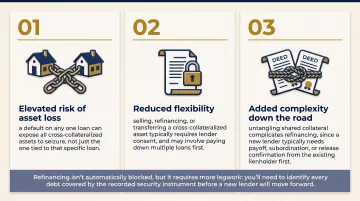
Refinancing isn't automatically blocked, but it requires more legwork: you'll need to identify every debt covered by the recorded security instrument before a new lender will move forward.
Cross-Collateralization in Bay Area Real Estate and Bridge Financing
Nowhere does cross-collateralization show up more often than in real estate bridge loans, and nowhere is speed more critical than in San Francisco's housing market. Redfin's data shows San Francisco homes currently draw roughly four offers on average and sell in about 14 days; San Jose isn't far behind.
In neighborhoods like Pacific Heights or Presidio Heights, that kind of pace means buyers rarely have the luxury of waiting for their current home to close before making an offer.
A bridge loan solves that timing problem. Your current home serves as collateral, sometimes alongside the new property, to finance the purchase before the first one sells. This structure lets you make a non-contingent offer, which carries real weight against competing buyers in a bidding war.
This is exactly the space where Golden Gate Lending Group (GGLG) operates. Founded by Sofia Nadjibi, who brings more than 25 years of mortgage lending experience, the firm specializes in structuring owner-occupied bridge financing for Bay Area homeowners navigating these multi-property transactions.
GGLG's approach centers on a few key differentiators:
- Loan sizes ranging from $1M to $15M for owner-occupied bridge financing
- Nearly $1 billion in loans closed to date
- Equity-based underwriting instead of traditional income qualification, which speeds approval when timing is tight
If you're considering this route, work with a lender who can walk you through exactly how collateral gets structured across your loans. Bridge and cross-collateralized arrangements carry more moving parts than a standard single-property mortgage, and the details matter, particularly what happens if one property doesn't sell as quickly as planned.
How to Get Out of a Cross-Collateralized Loan
Eventually, most borrowers want to unwind these arrangements. There are three realistic paths.
- Pay off the loan in full. This is the cleanest exit: once every obligation secured by the property is satisfied, the lender must release the lien. California Civil Code 2941 gives lenders 30 days to issue a discharge certificate after payoff.
- Renegotiate with your lender. You may be able to substitute alternative collateral or restructure loan terms to release one asset. This is a lender-approved modification, not an automatic right, and it can carry less favorable terms than your original agreement.
- Refinance with a new lender. This route can be harder than a standard refinance, since new lenders often hesitate to untangle existing cross-collateral agreements. Review your documents first — you need to know which debts tie to which properties before the process can start.

In every case, lender cooperation is the deciding factor. Understanding your loan documents before you're trying to exit them will save you time and stress later.
Frequently Asked Questions
What is an example of cross-collateralization in a loan?
A common example is a second mortgage or bridge loan, where your home's equity secures two loans at once. In Bay Area bridge financing, your current home often secures financing for a new purchase before it sells.
How do I get out of cross-collateralization on a loan?
Full repayment is the most direct path, releasing every asset tied to the loan. Alternatively, you can renegotiate terms with your existing lender or refinance with a new one, though both typically require lender consent.
Do banks use cross-collateralization for loans?
Yes, banks, credit unions, and mortgage lenders all use this structure. It's especially common with credit unions and within same-institution lending, where a borrower already holds multiple accounts or loans.
Is cross-collateralization legal?
Yes, it's legal and widely used, provided the lender discloses the arrangement and the borrower consents. This is typically documented through a dragnet clause in the loan agreement, which federal disclosure rules require lenders to spell out.
Can you sell a cross-collateralized property?
Generally, yes, but it requires lender approval first. You may need to pay down or restructure the linked loans before the lender will release its lien on the property you're selling.
Is cross-collateralization the same as a blanket mortgage?
Not quite. A blanket mortgage is one specific type of cross-collateralization, where multiple properties secure a single loan. It's a common tool for real estate investors managing several properties under one financing structure.