

Introduction
Finding your next home before your current one sells sounds like a dream scenario, until you're staring down two mortgage payments and a ticking clock. Move-up buyers and luxury homeowners across the Bay Area run into this dilemma constantly.
San Francisco's market isn't making it any easier. Pending sales jumped 17% year over year in September 2025, the sharpest increase of any major metro Redfin tracks. In a market moving that fast, waiting to sell first can cost you the house you actually want.
Buying before selling looks simple on paper. In practice, your outcome hinges on your financing strategy and how much equity sits locked in your current home.
This guide walks through the step-by-step process, the financing tools (including bridge loans) that make it work, and the mistakes that trip up even well-prepared buyers.
Key Takeaways
- Buying first avoids double moves but may mean carrying two mortgages temporarily
- Bridge loans, often paired with HELOCs or home equity loans, can cover the gap until your sale closes
- An experienced lender and agent make simultaneous transactions far smoother
- Rent-back agreements and extended closings ease the pressure of coordinating both sides
- This strategy suits financially stable buyers with strong equity, especially on higher-value homes
How to Buy a House Before Selling Yours: Step-by-Step
Buying before selling requires making several decisions in the right sequence. Get the order right and the process feels manageable. Skip a step and you'll feel it in your bank account.
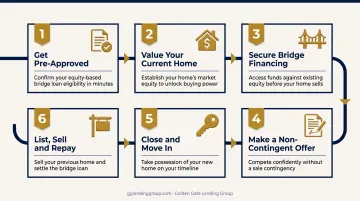
Step 1: Evaluate Your Home Equity and Financial Readiness
Start by subtracting your mortgage balance from your home's current market value. That's your working equity, and it's the foundation for nearly every financing option available to you.
Lenders offering bridge financing typically want to see a combined loan-to-value ratio well under 80% across both properties. Equity alone doesn't guarantee approval, though. Fannie Mae's underwriting guidance requires documentation showing you can actually carry the new home, the current home, the bridge loan, and other obligations at once.
To gauge readiness:
- Calculate your equity: current market value minus outstanding mortgage balance
- Estimate your combined LTV: total debt on both homes divided by combined property value
- Run your debt-to-income ratio: assume both mortgages are active simultaneously
- Stress-test the numbers: model a slower-than-expected sale
Nationally, 54% of repeat buyers used proceeds from their previous home's sale to fund their next purchase, according to NAR's 2025 buyer profile. That dependence on sale proceeds is exactly why lenders scrutinize your interim financing plan so closely.
Step 2: Get Preapproved and Explore Financing Options Early
Preapproval does two things: it tells you your real budget, and it signals to sellers that your offer has teeth. Don't stop at a standard mortgage preapproval, though.
Ask your lender specifically about bridge loan, HELOC, and home equity loan eligibility before you start touring homes. Standard mortgage preapproval often doesn't account for these products at all.
For high-value transactions, this matters even more. Lenders who specialize in owner-occupied bridge financing can structure loans that a generalist bank simply won't touch, particularly in the $1 million to $15 million range common across San Francisco, Marin County, and Silicon Valley.
Step 3: Work with an Agent (and Lender) Experienced in Simultaneous Transactions
Coordinating two closings is a different skill than handling one. An agent who's done it before knows how to sequence offers, negotiate contingencies, and keep both transactions from colliding.
The same logic applies to your lender. Firms that regularly work alongside real estate agents on dual transactions, similar to how Golden Gate Lending Group partners with agents from Compass, Coldwell Banker, and Sotheby's, tend to move faster because the coordination is already built into how they operate.
This partnership model matters most when competition is fierce. Some Bay Area buyers have had to beat out 20 competing offers on a single property, which meant structuring a no-contingency, cash-like bid with a two-week close. That's not achievable without a lender who already understands the mechanics.
Step 4: Negotiate Timeline Tools Into Your Contracts
Two contract features can buy you breathing room:
- Rent-back agreements let sellers stay briefly in their sold home while finalizing their next purchase, typically under 30 days per California's standard seller-possession form.
- Extended closing periods push past the standard 30-45 day window, giving you more time to sell your current property first.
Neither tool works automatically. You have to negotiate them into the contract upfront, so raise them early with your agent.
Step 5: List and Sell Your Current Home Strategically
List your current home as soon as your new purchase is underway. Every extra week of overlap means another week of carrying costs on your bridge financing.
Timing matters too. Spring tends to bring the strongest buyer demand in most California markets, and San Francisco is particularly seasonal, so research the best window for your specific neighborhood before setting a listing date.
Price realistically from day one. A home that sits unsold for months doesn't just delay your payoff, it actively increases what you'll pay in interest and carrying costs on the bridge loan.
Is Buying Before Selling Right for You? Weighing the Pros and Cons
This strategy isn't universally the right move. Whether it makes sense depends on your financial cushion, current market conditions, and how much risk you're comfortable carrying.
Benefits worth considering:
- No rushed house hunting under a sale deadline
- Move only once, skipping temporary housing altogether
- Ability to submit a competitive, non-contingent offer
- More negotiating leverage in multiple-offer situations
Drawbacks to plan for:
- Potential dual mortgage payments for weeks or months
- Harder qualification without sale proceeds already in hand
- Exposure to market value swings on the home you haven't sold yet
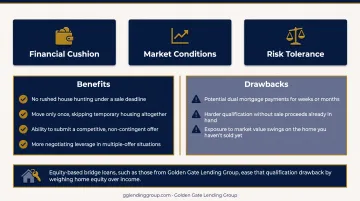
If your equity position is strong and your income can support two payments temporarily, buying first often wins. Equity-based bridge loans, such as those from Golden Gate Lending Group, ease that qualification drawback by weighing home equity over income. If your budget is tighter, the math may tilt the other direction.
Financing Options to Bridge the Gap Between Homes
Three tools dominate this space, each with different trade-offs.
Bridge Loans
A bridge loan lets you borrow against your current home's equity to fund the down payment on your new one, then repay it once your old home sells. It's especially useful when you need a non-contingent offer to compete.
This is a specialty product that requires strong equity and solid credit. It's a category lenders like Golden Gate Lending Group focus on almost exclusively, structuring owner-occupied bridge financing for buyers moving within markets like San Francisco and Marin County.
One case involved a retired East Bay couple with 30 years of accumulated equity who were declined by traditional lenders. A bridge loan let them structure an all-cash-equivalent, no-contingency offer on a home in Folsom, closing in roughly three weeks.
The trade-off: bridge loans carry higher interest rates and fees than a standard mortgage, and costs climb further if your current home takes longer than expected to sell.
Home Equity Loans and HELOCs
Both let you tap existing equity for a down payment while leaving your primary mortgage rate untouched.
| Feature | Home Equity Loan | HELOC |
|---|---|---|
| Funding | One lump sum | Repeated draws as needed |
| Rate | Usually fixed | Usually variable |
| Repayment | Fixed schedule | Draw period, then repayment |
| At sale | Paid off through proceeds | Paid off through proceeds |
A home equity loan works well when you know the exact amount needed upfront, while a HELOC offers flexibility if you're still finalizing your new home's price range. The added monthly payment on either product factors directly into your debt-to-income ratio, which is worth running through your lender before you count on either as your funding source.
Home Sale Contingency
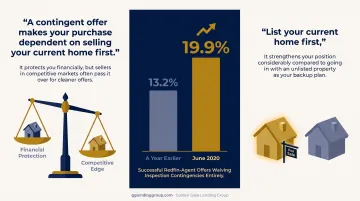
A contingent offer makes your purchase dependent on selling your current home first. It protects you financially, but sellers in competitive markets often pass it over for cleaner offers.
That preference for certainty extends across contingency types. In June 2020, 19.9% of successful Redfin-agent offers waived inspection contingencies entirely, up from 13.2% a year earlier, showing how aggressively sellers reward offers with fewer strings attached, home sale contingencies included.
If you're set on a contingent offer, list your current home first. It strengthens your position considerably compared to going in with an unlisted property as your backup plan.
Common Mistakes to Avoid When Buying Before Selling
Even well-funded buyers stumble here. The most common errors:
- Assuming a quick, full-price sale. Stress-test your budget against a slower sale or a lower-than-expected offer. Markets shift, and your bridge financing timeline should account for that.
- Underestimating true carrying costs. Two mortgages means two sets of property taxes, insurance premiums, and possibly HOA fees running simultaneously. Add these up before committing, not after.
- Waiting too long to secure financing or list. Delay on either front usually means missed opportunities on the buy side and prolonged double payments on the sell side. Securing early bridge loan pre-approval closes this gap.
These missteps often collide with a costlier mistake: removing contingencies before financing is confirmed. One buyer's team waived every contingency before their conventional loan was approved, then watched that lender decline the deal 60 days later, putting a $75,000 deposit at risk. Sequencing matters. Never remove contingencies without a confirmed funding source in hand.
Alternative Strategies If Buying First Isn't Feasible
Buying before selling isn't the only path. A few alternatives are worth considering if the numbers don't work:
- Sell first. This gives you a clear budget and a stronger negotiating position on your next purchase, though you may need temporary housing between transactions.
- Use a guaranteed offer or trade-in program. Companies like Opendoor, Knock, and Orchard let you lock in a price upfront before listing traditionally, though these programs typically pay less than an open-market sale would.
- Rent out your current home temporarily. If it doesn't sell quickly, renting can generate income while you keep searching, but confirm documentation requirements with your lender first, since converting a primary residence to a rental often requires extra paperwork.
Frequently Asked Questions
What to do before selling the house?
Declutter, handle minor repairs, and consider light staging before listing. Get a realistic home value estimate from your agent so your pricing strategy reflects actual market conditions, not wishful thinking.
What is the hardest part of selling a house?
Pricing accurately tends to top the list, along with coordinating the sale's timing against your next purchase. Overpricing stalls a sale; underpricing leaves money on the table.
What happens if I sell my house and don't buy another one?
You can rent temporarily, stay with family, or negotiate a rent-back agreement with your buyer while you continue searching. Many sellers use this window to shop without pressure.
What is the hardest month to sell a home?
December and January, right after the holiday rush, tend to see the slowest activity nationally. Buyer traffic picks back up noticeably by early spring in most California markets.
Can a bridge loan help me buy before selling in a competitive market?
Yes. Bridge loans let you make a non-contingent offer, which sellers generally prefer over offers dependent on another sale closing first. That preference often decides multiple-offer situations.
Is it better to buy or sell first in today's market?
It depends on your equity, local market conditions, and how much financial flexibility you have. Speak with a bridge loan specialist, such as Golden Gate Lending Group, to evaluate which path fits your specific numbers.