

This is the exact bind that trips up otherwise well-qualified San Francisco buyers. Conventional mortgages assume you have cash on hand or a closed sale behind you. They aren't designed for the timing gap between "I found my next home" and "my current one finally closed."
That gap is exactly what interim financing exists to solve. This guide breaks down what interim financing actually is, how the process works, what it costs, and what it takes to qualify, with a focus on how it plays out in San Francisco's luxury market.
Key Takeaways
- Interim financing bridges the gap between buying a new home and selling your current one.
- Terms run from a few weeks to under a year, ending in one lump-sum repayment.
- Rates and fees exceed standard mortgages due to short terms and added lender risk.
- Home equity and an executed sale on your current property matter more than credit score.
- Golden Gate Lending Group structures interim and bridge loans from $1M to $15M for Bay Area luxury buyers.
What Is Interim Financing?
Interim financing is a temporary loan that lets you close on a new home before the sale proceeds from your current property, or a permanent mortgage, become available. It's a short-term solution designed to get you across the finish line on a purchase without waiting on a sale you can't control the timing of.
Federal regulators actually put a number on this. The Consumer Financial Protection Bureau's Regulation Z defines a temporary or "bridge" loan as one with a term of 12 months or less, explicitly citing the scenario of financing a new home while planning to sell a current one within that window. That's the controlling federal definition, not just marketing language.
Here's where it gets confusing for homebuyers: the term "interim financing" gets used loosely across the industry.
- Some lenders and brokers treat "interim financing" and "bridge loan" as interchangeable terms
- Others use "interim" as a broader category that includes bridge loans, HELOCs, and private financing arrangements
- In a construction context, "interim financing" means something entirely different: a construction loan that gets replaced by a permanent mortgage once the build is complete
For this guide, we're focused on the purchase scenario: covering the equity gap between an unsold current home and a new one you want to buy now.
Interim Financing vs. Bridge Loans vs. HELOCs
A true bridge loan is secured against equity in a home you've sold but haven't closed on yet, or one that's actively under contract. It's a distinct, short-term loan built for exactly one purpose.
A HELOC works differently. It's revolving credit secured by home equity, meant for ongoing access to funds rather than a one-time transitional purchase.
There's also a practical problem: most lenders won't approve a new HELOC once your current home is actively listed for sale. Citizens Bank, for example, states its HELOC is unavailable on homes currently for sale and requires a previously listed property to be off market for at least 90 days before applying.
That timing restriction is exactly why bridge loans remain the go-to route for luxury sellers who need funds while mid-listing.
How Interim Financing Works: Process & Example
Before a lender will issue a bridge or interim loan, they typically need to see one thing: an accepted sale, or removed contingencies, on your current home. This isn't universal across every lender, but it's the standard prerequisite in most residential bridge programs.
Once that's in place, the funding process generally follows this pattern:
- Application and needs assessment – You share details on both properties: the one you're buying and the one you're selling, along with your equity position.
- Lender review of equity and collateral – The lender evaluates your current home's equity, the pending sale terms, and the new purchase price.
- Loan approval – With equity and sale strength confirmed, the lender structures loan terms specific to your transaction.
- Disbursement at closing – Funds are released to close on the new home, often alongside a new first mortgage and your own cash contribution.
- Final repayment – When your departing home sells, the proceeds pay off the interim loan directly through escrow.
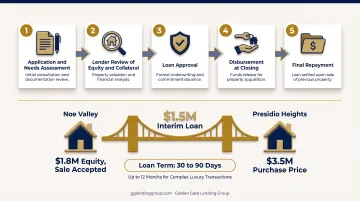
A realistic example: Say you own a home in Noe Valley with $1.8 million in equity, and you've accepted an offer on it. You want to buy a $3.5 million home in Presidio Heights before that sale closes.
The numbers break down like this:
- Current home equity: $1.8 million, with sale already accepted
- New home price: $3.5 million in Presidio Heights
- Interim loan: covers $1.5 million of the equity gap
- Repayment: Noe Valley sale proceeds retire the loan through escrow weeks later
Most interim loans are structured for 30 to 90 days, though asset-based luxury lenders sometimes extend terms up to 12 months for complex, high-value transactions where the sale timeline is less predictable.
Interim Financing Costs, Rates & Qualification Requirements
Interim financing costs more than a standard 30-year mortgage. That's the trade-off for speed and flexibility. According to Amerisave's bridge loan guide, residential bridge rates run roughly 2 to 4 percentage points above standard first-mortgage rates, with origination fees typically in the 1% to 3% range, depending on the lender and transaction complexity.
Beyond origination fees, expect these typical costs:
- Appraisal fees on both the departing and new property
- Title and escrow charges tied to the interim loan's closing
- Administrative or underwriting fees, which vary based on loan complexity and size
For luxury transactions in the $1M-$15M range, fee structures are negotiated individually rather than pulled from a standard rate sheet.
Who Pays Interim Interest?
The borrower pays interest on the interim loan for as long as it's outstanding. How you pay it varies by lender: some allow monthly interest-only payments, while others let accrued interest roll into the final payoff when the departing property sells.
Ask your lender which structure they offer before you commit; it affects your monthly cash flow during the overlap period.
What Credit Score Is Needed for a Short-Term Loan?
Credit still matters, but it's not the whole story. According to Rocket Mortgage's bridge loan program, the lender pairs a 680 minimum FICO score with a maximum 80% loan-to-value, allowing borrowers to reach 90% LTV if their credit score reaches 740. In other words, credit and leverage get underwritten together, not independently.
For high-value luxury transactions, this dynamic shifts even further toward equity. Asset-based and equity-based underwriting, rather than strict income and debt-to-income ratios, is how lenders like Golden Gate Lending Group evaluate $1M-$15M interim loans for owner-occupied purchases.
A strong sale contract and substantial equity position can carry real weight, even for borrowers whose income documentation doesn't fit a conventional mortgage box.
Common Uses, Advantages & Disadvantages of Interim Financing
Typical Uses for Interim Financing
Interim financing shows up most often in a few recurring scenarios:
- Buying a new home before an existing one sells, so you can submit a stronger, non-contingent offer in a competitive market
- Funding a relocation, family upsizing, or downsizing move without waiting on a closed sale
- Acquiring an investment or multi-unit property while your current asset is still listed
Advantages and Disadvantages
Interim financing isn't free money, and it isn't the right fit for every situation. Here's the honest trade-off:
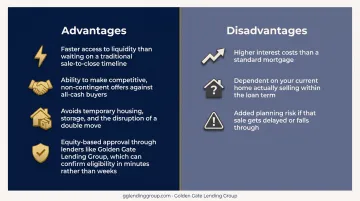
Advantages:
- Faster access to liquidity than waiting on a traditional sale-to-close timeline
- Ability to make competitive, non-contingent offers against all-cash buyers
- Avoids temporary housing, storage, and the disruption of a double move
- Equity-based approval through lenders like Golden Gate Lending Group, which can confirm eligibility in minutes rather than weeks
Disadvantages:
- Higher interest costs than a standard mortgage
- Dependent on your current home actually selling within the loan term
- Added planning risk if that sale gets delayed or falls through
Why Work With Golden Gate Lending Group for Interim Financing
Structuring an interim loan on a multimillion-dollar San Francisco property isn't the same transaction as a standard bridge loan on a median-priced home. It requires a lender who understands luxury underwriting, tight timelines, and the discretion high-net-worth buyers expect.
Golden Gate Lending Group specializes exclusively in owner-occupied bridge and interim financing from $1 million to $15 million across California's luxury real estate market. Founded in 2015 by Sofia Nadjibi, MBA, the firm brings more than 25 years of mortgage lending experience to every deal.
That expertise shows up in the numbers:
- Closed nearly $1 billion in loans since founding
- Helped more than 500 families move into their next home without waiting on a sale
- Built trusted partnerships with agents at Compass, Coldwell Banker, and Sotheby's International Realty
- Serves San Francisco's premier neighborhoods, from Pacific Heights to Noe Valley, plus the greater Bay Area, Marin County, and Silicon Valley
What sets the approach apart is how personal it stays despite that scale. Every transaction gets structured around your specific equity position, timeline, and privacy needs, not a generic underwriting template.
If you're weighing your options on a purchase before your current home sells, scheduling a consultation is the fastest way to find out what's possible for your situation.
Frequently Asked Questions
What is interim financing?
Interim financing is a short-term loan that bridges the timing gap between purchasing a new property and receiving funds from a pending home sale or permanent financing. It's typically repaid in a lump sum once your current home closes.
Who pays interim interest?
The borrower pays interest on the interim loan throughout its term. Depending on the lender, you'll either make monthly interest-only payments or have the accrued interest rolled into the final payoff at sale.
What credit score is needed for a short-term loan?
Many programs look for a credit score around 680 or higher. Equity position and the strength of your departing home's sale contract often carry more weight, especially with asset-based luxury lenders.
How long does interim financing typically last?
Most interim loans run from a few weeks up to 12 months, with 30 to 90 days being common. Luxury and asset-based lenders sometimes offer more flexible terms for complex transactions.
Is interim financing the same as a bridge loan?
The terms are frequently used interchangeably in residential real estate. Technically, "interim financing" can be a broader category that also includes HELOCs, private loans, or construction financing.
Can I get interim financing before my current home is under contract?
Most lenders require an accepted sale or contingencies removed on your current property before approving interim or bridge financing. Exceptions are rare and typically case-by-case, so it's best to discuss your specific timeline with our team.