

That's the exact gap residential transition loans were built to fill. Traditional mortgages are underwritten for owner-occupied, move-in-ready homes with predictable income documentation. They aren't designed for distressed properties, non-owner-occupied investments, or homes mid-construction. That leaves renovators and builders searching for financing that moves at the speed of a competitive market.
This guide breaks down what residential transition loans (RTLs) actually are, how they're structured and priced, the risks worth understanding before signing, and who they're really built for.
Key Takeaways
- Residential transition loans are short-term, business-purpose loans for renovating or rehabbing rental property
- RTLs carry different underwriting and pricing than conventional loans, trading speed for cost
- Loan sizing often hinges on After-Repair Value (ARV), not just current condition
- Success hinges on a realistic exit: selling or refinancing before the balloon payment comes due
What Is a Residential Transition Loan?
A residential transition loan is a short-term, asset-based loan secured by a first lien on a non-owner-occupied residential property. Terms typically run up to 36 months, payments are interest-only, and the full principal comes due as a single balloon payment at maturity.
Underwriting here centers on the deal itself: the property, the renovation plan, and the exit strategy.
Business-Purpose Loans, Different Rules
RTLs are classified as "business purpose" loans because the borrower is buying to renovate and resell or rent, not to live in. That classification matters:
- Regulation Z exempts credit primarily for business or commercial purposes from the CFPB's Ability-to-Repay/Qualified Mortgage rule
- TRID disclosures, standard on most consumer mortgages, generally don't apply either
- The tradeoff is faster closings and more underwriting flexibility, but fewer of the consumer protections built into a standard home mortgage
ARV-Based Underwriting and Staged Funding
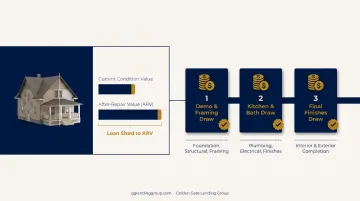
Instead of lending only against the property's current, distressed condition, most RTL lenders size the loan around its After-Repair Value (ARV), a third-party appraiser's estimate of what the home will be worth once renovation is complete.
Rehab dollars usually aren't handed over in one lump sum. Lenders hold back a rehabilitation amount and release it in stages, tied to renovation milestones. Finish demo and framing, get a draw. Finish the kitchen and bath, get another. This protects the lender's collateral and keeps borrower cash flow tied to real progress.
Different Names, Same Loan Category
You'll hear this product called several things depending on who's talking:
- Fix-and-flip loan
- Hard money loan
- Residential bridge loan
- RTL
They all describe the same short-term, project-based financing category. What's changed is scale. A January 2025 sample of private bridge loans tracked by the American Association of Private Lenders averaged 10.83% in interest, with most loans priced between 9% and 12.99%. That pricing consistency points to a mature, multi-billion-dollar lending niche with clearly defined norms.
How Do Residential Transition Loans Work?
From Application to Closing
RTL underwriting looks nothing like a conventional mortgage application. Instead of pay stubs and tax returns, lenders want to understand the deal:
- Property and project evaluation - purchase price, scope of work, and projected ARV
- Borrower experience and exit plan - has the investor done this before, and how will the loan be repaid?
- Collateral-based underwriting - the property secures the loan, not the borrower's income
Golden Gate Lending Group, for example, approves its bridge loan products primarily on equity and asset value rather than income documentation. Pre-approval decisions are available in under five minutes, and closings often complete within about two weeks of contract execution. That turnaround simply isn't possible with a loan that requires full income underwriting.
Interest-Only Payments, Balloon Repayment
During the loan term, borrowers typically pay interest only. There's no amortization chipping away at principal each month. The full balance, the original advance plus any rehab draws taken, comes due in one lump sum at maturity or upon sale or refinance, whichever happens first.
This keeps monthly carrying costs lower during the renovation. It also means the exit has to happen on schedule.
How the Holdback and Draw Process Works
Renovation funds don't sit in the borrower's account waiting to be spent. They're released in phases:
- The borrower completes a defined phase of work, such as demolition or framing
- An inspector or third party verifies the work was completed
- The lender releases the corresponding draw
- The cycle repeats until the rehab is finished
That structure keeps incentives aligned. The lender isn't funding work that hasn't happened, and the borrower has a built-in checkpoint at each project stage.
The Six-Month Rule: What It Actually Means
Investors often ask about a "six-month rule" for cashing out on ARV. Here's the real version: Fannie Mae and Freddie Mac generally require a borrower to have held title for at least six months before a cash-out refinance. Separately, an existing first mortgage being paid off usually needs to be at least 12 months old, subject to exceptions like delayed financing.
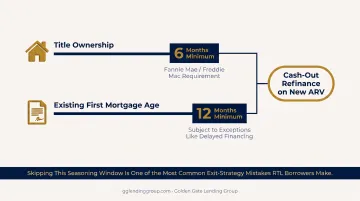
In practice, this means an investor who renovates a property and wants to refinance based on its new, higher value, rather than the original purchase price, often needs to plan around this seasoning window. Skipping this step is one of the most common exit-strategy mistakes RTL borrowers make.
Residential Transition Loans vs. Traditional Mortgages
Who Qualifies
Conventional mortgages are built for owner-occupants. Underwriters lean heavily on personal income, debt-to-income ratio, and credit history.
RTLs flip that model:
- Borrowers are frequently LLCs, corporations, or individual investors buying strictly for business purposes
- Personal income and DTI carry far less weight
- The property's equity and projected post-renovation value drive the decision
Structure and Term Length
RTLs and conventional mortgages also diverge sharply in structure and repayment, as the table below shows.
| Feature | Residential Transition Loan | Conventional Mortgage |
|---|---|---|
| Term | Up to 36 months | 15 to 30 years |
| Payment type | Interest-only | Fully amortizing |
| Repayment | Balloon payment at maturity | Gradual principal paydown |
| Occupancy | Non-owner-occupied | Primarily owner-occupied |
That short, interest-only window reflects the loan's purpose: fund the renovation, then exit through sale or refinance.
The Cost of Speed
RTLs cost more than a conventional mortgage. That premium buys speed and flexibility, plus financing for a property a bank wouldn't touch in its current condition.
As noted above, private bridge loans averaged around 10.83% in January 2025. Compare that to Freddie Mac's weekly national survey, which tracks conventional 30-year fixed rates in the mid-to-high 6% range. These are separate benchmarks measured at different points, not a live spread, but the gap illustrates the general premium borrowers pay.
Borrowers also pay origination points, often several percentage points of the loan amount, on top of the interest rate. Pricing depends on:
- Loan-to-ARV ratio
- Borrower experience
- Project scope and complexity
- Overall market conditions
That premium reflects real risk. Lenders are financing an unfinished project with uncertain resale timing, rather than a stabilized asset with a proven income stream.
Benefits and Risks of Residential Transition Loans
Why Investors Use Them
- Speed - Closing quickly lets investors compete for time-sensitive deals, where a slow offer often loses out entirely in Bay Area markets
- Flexible underwriting - ARV-based lending qualifies properties and projects that would never pass conventional guidelines
- Aligned funding - Staged holdback disbursements match capital release to renovation progress, protecting collateral while giving borrowers predictable cash flow
Where the Risk Lives
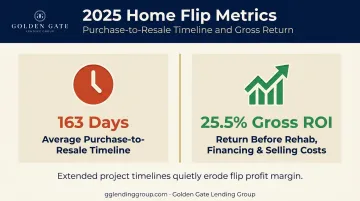
Higher rates plus a short loan term create a tight margin for error. ATTOM's 2025 home flipping data found the average flip took 163 days from purchase to resale, with gross ROI at 25.5% before rehab, financing, and selling costs. Every extra week a project drags on eats directly into that margin.
The bigger risk is structural: the balloon payment. A borrower who can't sell or refinance on schedule faces a narrow set of options:
- Negotiate a costly loan extension
- Refinance into another short-term product at another rate
- Face default or a forced sale
Each option carries real costs, whether in fees, higher rates, or lost equity. A dependable, realistic exit strategy isn't optional with an RTL - it's the foundation the loan rests on.
Who Should Consider a Residential Transition Loan?
RTLs tend to fit three borrower profiles:
- Experienced fix-and-flip investors buying distressed properties to renovate and resell within months
- Small builders doing ground-up construction on infill lots
- Buy-and-hold investors running a renovate-then-refinance strategy, known as BRRRR (Buy, Rehab, Rent, Refinance, Repeat), where the RTL covers the buy and rehab before refinancing
Institutional capital has moved into this space in a real way. But a large share of the market still rewards borrowers who work with lenders who actually know the neighborhood, not just the spreadsheet.
Golden Gate Lending Group works in exactly that space for fix-and-flip and buy-and-hold investors. Based in Corte Madera, the firm structures bridge and renovation financing across San Francisco, Marin County, Silicon Valley, and the East Bay.
With more than $1 billion funded and trusted relationships with agents at Compass, Coldwell Banker, and Sotheby's, the firm brings a level of local feasibility assessment that a national platform lender typically can't replicate.
For an investor evaluating a fixer-upper in Noe Valley or a buy-and-hold investor scoping a BRRRR deal in the East Bay, that local knowledge often matters as much as the rate on the loan. You can start an application directly to see what a specific project might qualify for.
Frequently Asked Questions
What is a residential transition loan?
A residential transition loan is a short-term, business-purpose loan used to finance the renovation, rehab, or construction of a non-owner-occupied residential property. It's typically repaid through a sale or refinance once work is complete.
What is the 6-month rule for mortgages?
Fannie Mae and Freddie Mac require borrowers to hold title for six months before a cash-out refinance based on improved value, plus a 12-month rule for payoff of an existing first mortgage. This determines how soon an RTL borrower can refinance out.
How much does a residential transition loan cost?
Rates typically run well above conventional mortgage rates, often in the high single digits to low double digits, plus origination points due at closing. Exact pricing depends on borrower experience, loan-to-ARV ratio, and project scope.
What's the difference between a hard money loan and a residential transition loan?
"Hard money loan" and "RTL" are largely used interchangeably to describe the same short-term, asset-based financing category. The main difference today is that many RTLs now originate through more institutionalized lending platforms rather than purely local private lenders.
How quickly can a residential transition loan close?
Because underwriting focuses on the property and project rather than income documentation, RTLs can close significantly faster than conventional mortgages. Golden Gate Lending Group, for instance, targets closings around two weeks from contract execution for its bridge loan products.
Can a residential transition loan be used for an owner-occupied home?
No. RTLs are business-purpose loans intended for non-owner-occupied investment properties. Owner-occupants who need short-term financing to buy before selling typically need a different bridge loan product structured for consumer use.