

Introduction
In Pacific Heights, Presidio Heights, and across Marin County, 2026 has brought a familiar standoff. Move-up buyers see the home they want, but their equity is locked inside the house they still own.
Sellers in competitive Bay Area markets routinely pass over contingent offers. Most buyers can't qualify for two mortgages at once under standard debt-to-income rules. That leaves them stuck in a chicken-or-egg dilemma: sell first and risk temporary housing, or buy first and risk carrying two homes.
This guide breaks down how Buy Before You Sell programs work in 2026, the different structures on the market, and why specialized owner-occupied bridge financing is often the smarter path for high-value Bay Area transactions.
Key Takeaways
- Bridge loans, guaranteed offers, or equity-unlock structures all remove sale contingencies
- Loan-based bridge financing preserves ownership control; rent-back models often trigger double payments
- For $1M+ properties, how a program treats your mortgage matters more than its marketing
- Roughly 60% of 2025 home sellers were also concurrent buyers, making this a structural market issue, not a niche one
- A local lender fluent in luxury bridge financing offers more flexibility than national platforms
What Is a Buy Before You Sell Program in 2026?
A Buy Before You Sell (BBYS) program is short-term financing, or a contractual structure, that lets a homeowner purchase their next home before their current one sells. The point is simple: eliminate the sale contingency that scares off sellers in competitive markets.
These programs exist because move-up buyers face two distinct problems:
The down payment challenge: most of their net worth sits locked in home equity they can't access until closing
The qualification challenge: carrying two mortgages simultaneously blows past standard debt-to-income limits at most banks
The cost challenge: bridge loans carry higher rates and fees than conventional financing, a tradeoff many buyers accept in exchange for a stronger offer
How These Programs Have Evolved for 2026
The category has shifted noticeably over the past two years. What started as straightforward bridge loans has expanded into a mix of models, with major players scaling different approaches:
- Knock launched an enhanced Bridge Loan Plus product in late 2025, raising its maximum loan size to $1 million
- Flyhomes exited direct brokerage to focus entirely on wholesale BBYS lending distributed through loan officers
- Orchard reported 40% company-wide growth in 2025, alongside a $30 million funding round
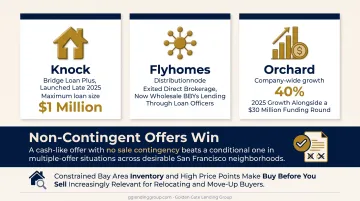
That growth traces back to a simple seller preference: non-contingent offers win, particularly in multiple-offer situations common across desirable San Francisco neighborhoods. A cash-like offer with no sale contingency simply beats a conditional one, all else being equal.
In the Bay Area specifically, constrained inventory and high price points make BBYS strategies increasingly relevant for relocating and move-up buyers. These buyers often can't afford to lose their next home over financing logistics.
Why Buy Before You Sell Matters for Bay Area & Luxury Buyers in 2026
Two forces are colliding in San Francisco right now: homeowners who won't sell, and prices that keep climbing anyway.
The Mortgage Rate Lock-In Effect
Many Bay Area homeowners refinanced or bought when rates sat well below today's levels, and they're reluctant to give that up. Redfin's Q2 2025 analysis found that 52.5% of mortgaged U.S. homeowners had rates below 4%, and 70.4% held rates below 5%.
That gap keeps inventory tight in Nob Hill, Sea Cliff, and Noe Valley, since fewer owners are willing to trade a low fixed rate for a much higher one. For homeowners who need to move, this lock-in effect makes a sale-first approach riskier, since finding a replacement home in a tight market can take months.
Bay Area Price and Inventory Snapshot
Meanwhile, prices haven't softened. C.A.R.'s June 2026 report put the Bay Area median single-family home price at $1.4 million, with San Francisco County alone hitting $2.128 million, up nearly 25% year-over-year.
| Geography | June 2026 Median | YoY Change |
|---|---|---|
| Bay Area (overall) | $1,400,000 | 0.0% |
| San Francisco County | $2,128,000 | +24.8% |
| Marin County | $1,775,000 | +7.6% |
| San Mateo County | $2,310,000 | +7.9% |
Buyers at the $1M-$15M price point often carry substantial equity, but unlocking it strategically, without disrupting their finances or triggering unnecessary tax events, requires more planning than a standard sale.
There's also the physical burden. Luxury households often face temporary housing, storage costs, and the logistics of moving art, furnishings, or wine collections twice instead of once. That's real money and real stress, not just inconvenience.
This isn't a fringe concern. As referenced above, roughly 60% of 2025 sellers were also concurrent buyers, according to a Realtor.com analysis reported by USA Today. That's a structural feature of the current market, not a temporary blip. Golden Gate Lending Group has funded more than $1 billion in bridge loans for Bay Area homeowners navigating exactly this timing gap.
Types of Buy Before You Sell Programs: Bridge Loans, Guaranteed Offers & Equity Unlock
Not all BBYS programs work the same way. Three models dominate the market in 2026:
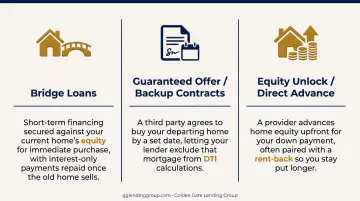
- Bridge loans — short-term financing secured against your current home's equity for immediate purchase, with interest-only payments repaid once the old home sells.
- Guaranteed offer/backup contracts — a third party agrees to buy your departing home by a set date, letting your lender exclude that mortgage from DTI calculations.
- Equity unlock/direct advance — a provider advances home equity upfront for your down payment, often paired with a rent-back so you stay put longer.
Loan-Based vs. iBuyer-Style Rent-Back Models
The mechanics differ more than the marketing suggests:
| Factor | Loan-Based Bridge Financing | iBuyer/Rent-Back Style Programs |
|---|---|---|
| Ownership of new home | Immediate | Sometimes delayed via rent-back |
| Control over sale price | Full control | Often limited by program terms |
| Double payments | Possible, but manageable with interest-only structure | Common until the old home sells |
| Fee structure | Interest plus standard loan costs | One-time program fees, publicly disclosed at roughly 2.25%-2.4% of the departing home's sale price in 2025 |
Beyond these mechanics, owner-occupied bridge financing built for high-value primary residences differs meaningfully from investor-focused hard money bridge loans. Underwriting for a primary home purchase weighs occupancy, equity position, and the borrower's transition plan, not the fix-and-flip timeline or exit strategy that drives investor loan terms. Golden Gate Lending Group structures its Owner-Occupied Bridge Loans around this exact distinction, approving primarily on home equity rather than income documentation.
How to Qualify & Choose the Right Program for You
Qualification standards vary by lender and structure, but a few factors show up consistently:
- Minimum home equity — traditional bridge programs commonly require 15%-20% equity, though some luxury transactions call for a deeper cushion depending on the property and structure
- Credit profile — most programs favor established credit histories, though equity-based underwriting can offer flexibility here
- Treatment of your existing mortgage — some programs exclude it from DTI entirely; others don't, which changes what you can qualify for
- Primary-residence requirements — owner-occupied programs are built around your current home, not investment property
Beyond qualification, a few practical questions should guide your decision:
- What's your realistic timeline to sell? A faster local market changes your risk tolerance.
- Are you comfortable with potential double payments, even temporarily?
- Do you want full ownership and pricing control, or are you fine with a rent-back arrangement?
- Is the program even available at your price point and location?
That last question matters more than it seems. Few national platforms are built to serve $1M-$15M jumbo and non-conforming price points well, which is exactly why experienced local lenders remain essential for luxury Bay Area transactions.
Why Bay Area Buyers Choose Golden Gate Lending Group for Buy Before You Sell Financing
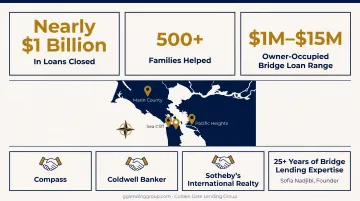
Golden Gate Lending Group operates as a boutique alternative to algorithm-driven national platforms. The firm structures owner-occupied bridge financing from $1 million to $15 million for buyers across San Francisco's most desirable neighborhoods, from Pacific Heights to Sea Cliff to Marin County.
This approach has produced measurable results for Bay Area buyers:
- Nearly $1 billion in loans closed
- Over 500 families helped through the buy-before-sell transition
- Trusted referral partnerships with agents from Compass, Coldwell Banker, and Sotheby's International Realty
Behind those results is founder Sofia Nadjibi, who brings more than 25 years of mortgage lending experience with a specific focus on structuring bridge financing for California's luxury market. That background translates into personalized, discreet deal structuring instead of a generic application process — the level of service high-value transactions demand when millions of dollars and a tight closing window are on the line.
Frequently Asked Questions
Is it worth selling your house to a house buying company?
It depends on your priorities. House-buying companies offer speed and certainty, but usually at a discount to market value. Buy Before You Sell financing lets you hold out for full market price while still buying your next home first.
What's the difference between a Buy Before You Sell program and a traditional bridge loan?
"Buy Before You Sell" is a broader category that can include bridge loans, guaranteed offers, or equity-unlock structures. A bridge loan specifically refers to short-term financing secured against your existing home equity.
How much equity do I need to qualify for a Buy Before You Sell program?
Most programs require a substantial equity cushion, commonly in the 15%-20% range for traditional bridge loans, though requirements vary by lender, structure, and property value.
What happens if my current home doesn't sell within the program's timeline?
Outcomes vary by provider. Some guaranteed-offer programs will purchase the home at an agreed value, while bridge loan structures may require extensions, refinancing, or additional payments.
Can Buy Before You Sell strategies work for luxury homes priced over $1 million?
Yes. Specialized lenders like Golden Gate Lending Group structure owner-occupied bridge financing specifically for $1M-$15M properties, a segment many national BBYS platforms don't serve well.
How quickly can I close on Buy Before You Sell financing in the Bay Area?
Timelines vary by lender and complexity, but experienced local bridge lenders can often move faster than national platforms thanks to efficient, relationship-based underwriting.