
That gap creates real consequences. Buyers competing for homes in Pacific Heights or Noe Valley regularly lose deals because their lender didn't move fast enough, or didn't understand how local bidding wars actually work. A slow pre-approval or an underwriter unfamiliar with multi-unit properties in SoMa can cost a buyer the house.
This guide breaks down the loan types Bay Area buyers actually use, explains how bridge financing solves the "buy before you sell" problem, and outlines what to look for in a lending partner who understands this market.
Key Takeaways
- Bay Area home prices often exceed conforming loan limits, increasing demand for equity-based bridge loan financing
- Bridge loans help equity-rich homeowners buy before selling, avoiding contingent offers many sellers reject
- Lenders with strong real estate agency relationships tend to close faster and build seller confidence
- Multi-unit and investment properties require equity-based underwriting and higher cash reserves
Why the Bay Area Lending Market Is Different
Financing a Bay Area home isn't like financing a home in most of the country. The math simply doesn't work the same way once prices climb past federal loan ceilings.
Conforming Loan Limits vs. Bay Area Home Prices
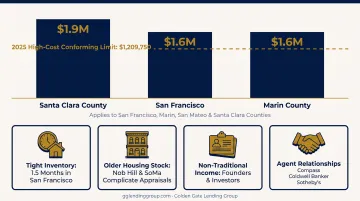
The Federal Housing Finance Agency set the 2025 high-cost conforming loan limit at $1,209,750 for one-unit properties in San Francisco, Marin, San Mateo, and Santa Clara counties. Anything above that threshold requires jumbo financing.
That threshold matters because typical sale prices are already testing it. Santa Clara County's median existing single-family home hit $1.9 million in July 2025, while San Francisco and Marin both cleared $1.6 million. A large share of ordinary purchases, not just luxury estates, now land in jumbo territory.
Several other factors compound the complexity:
- Tight inventory: San Francisco carried just 1.5 months of unsold inventory in July 2025, keeping pressure on buyers to move fast
- Older housing stock: Historic homes in Nob Hill and converted multi-unit buildings in SoMa often complicate appraisals and add underwriting steps
- Non-traditional income: Many buyers are relocating tech professionals, founders, or investors whose income doesn't fit a standard W-2 file
- Agent relationships: Lenders with established ties to firms like Compass, Coldwell Banker, or Sotheby's often move faster because agents already trust their pre-approval letters
Types of Lending Services Available in the Bay Area
Buyers here typically encounter three broad categories: conventional loans that follow Fannie Mae or Freddie Mac guidelines, jumbo loans for amounts above the county limit, and portfolio loans that a lender originates and holds rather than sells. Each comes with its own qualifying logic.
Jumbo and Portfolio Loans for Luxury Properties
Jumbo loans carry no universal underwriting standard. The Consumer Financial Protection Bureau notes that qualification rules vary by lender but generally involve strong credit, documented income, and meaningful cash reserves. Lenders typically want to see:
- Detailed income documentation, especially for self-employed or equity-compensated buyers
- Larger reserve requirements than conforming loans
- A credit profile that supports the loan-to-value ratio being requested
Portfolio loans exist for buyers who don't fit neatly into that box.
Business owners with complex tax returns or high-net-worth individuals with irregular income often qualify more easily this way. Golden Gate Lending Group's bridge and hard money loans, for example, are underwritten primarily on home equity rather than income, fitting this profile well.
Investment and Multi-Unit Property Financing
San Francisco's housing stock includes plenty of duplexes, triplexes, and small apartment buildings, and financing them works differently than a single-family purchase. Fannie Mae generally counts only 75% of documented gross rental income toward qualifying income, reserving the rest for vacancy and upkeep.
Investment purchases also typically require six months of reserves, plus additional reserves scaled to how many other financed properties the borrower already holds.
Down payment expectations run higher too. Two- to four-unit investment purchases commonly max out around 75% loan-to-value, meaning investors need more skin in the game than an owner-occupant would.
Home Upgrade and Relocation Financing
Families moving up within the Bay Area, or relocating from another market entirely, have a few standard paths: cash-out refinancing on a departing residence, second-home financing, or a new purchase loan tied to relocation income.
Each option works fine when timing isn't tight. The trouble starts when a family needs to close on a new home before their current one sells.
That's exactly the gap bridge financing fills. Golden Gate Lending Group's Buy Before You Sell program unlocks equity from the departing home so buyers can make a non-contingent offer without waiting on a sale.
Bridge Financing: A Bay Area Specialty Worth Understanding
That timing problem is exactly what bridge financing solves, and it's become something of a Bay Area specialty given how often buyers need to move fast without a sale already locked in.
The National Association of Realtors describes a bridge loan, sometimes called a swing loan, as short-term financing that lets a homeowner tap equity in their current residence before that home sells. The funds typically cover a down payment or, in some structures, the full purchase price of the next home.
Here's how it usually plays out:
- The homeowner's existing equity is used as collateral
- Bridge funds cover the down payment (or full purchase) on the new property
- The buyer submits a non-contingent offer, competing on equal footing with cash buyers
- Once the original home sells, proceeds pay off the bridge loan
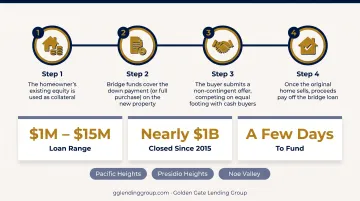
That fourth step is why bridge loans matter so much in neighborhoods like Pacific Heights or Presidio Heights, where sellers routinely favor offers without a home-sale contingency. A contingent offer signals risk to a seller. A bridge loan removes that risk from the equation entirely.
Golden Gate Lending Group has built its entire practice around this exact scenario. The Corte Madera-based firm specializes in owner-occupied bridge financing for California's luxury market, structuring loans from $1 million to $15 million and closing nearly $1 billion in loans since founder Sofia Nadjibi launched the company in 2015.
Approval leans on home equity rather than a lengthy income-documentation file. That structure lets the firm fund deals in as little as a few days — a pace that matters when a competitive offer is due within 48 hours.
The ideal bridge loan candidate fits a specific profile:
- Equity-rich in their current home
- Needs to close on a new property before the existing one sells
- Wants to compete against cash offers without carrying two mortgages indefinitely
Buyers with minimal equity won't qualify. For the right profile, though, a bridge loan can be the difference between winning a Noe Valley bidding war and starting the search over.
How to Choose the Right Bay Area Lending Partner
Not every lender is built for this market. A handful of criteria separate the ones who can actually deliver from the ones who'll slow a deal down.
Look for:
- Local market fluency: understands why a 1920s Nob Hill building appraises differently than new construction in the Peninsula
- Responsiveness: answers calls during an active bidding situation, not two days later
- Product flexibility: access to jumbo, portfolio, or bridge structures depending on what the deal requires
- Agency relationships: ties with firms like Compass, Coldwell Banker, and Sotheby's agents, which smooth communication and reassure sellers that financing is real
Credentials help narrow the field, too. Look for these trust signals:
- BBB accreditation with an A+ rating for verified service quality
- A track record measured in years, not months
- Total funded loan volume that shows real transaction experience
- A Scotsman Guide ranking, which requires verified proof of at least $25 million in annual production
That verification standard means a ranking reflects real, audited volume rather than marketing claims.
Navigating the Bay Area Loan Process
The mechanics of a Bay Area bridge loan follow a familiar sequence, but the timeline compresses hard once multiple offers enter the picture.
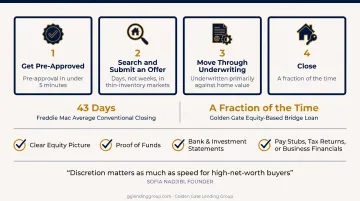
- Get pre-approved. Equity-based bridge loan pre-approval can be completed in under five minutes, giving buyers immediate confidence to compete for the right property.
- Search and submit an offer. In neighborhoods with thin inventory, buyers often have days, not weeks, to act once a property hits the market.
- Move through underwriting. Equity-based bridge loans underwrite primarily against home value, so appraisal complexity and property type matter more than income paperwork.
- Close. Freddie Mac reports an average purchase-loan closing time of 43 days for conventional financing, while Golden Gate Lending Group's equity-based bridge loans typically close in a fraction of that time.
Having documentation ready before the right property appears makes all the difference, and equity-based bridge loans prioritize home value over income paperwork:
- A clear equity picture, including current home value and any existing mortgage balance
- Proof of funds for down payment and reserves
- Bank and investment account statements
- Pay stubs, tax returns, or business financials, if a lender requests them
For high-net-worth buyers, discretion matters as much as speed. Complex transactions, whether they involve a family trust, a business sale, or a relocation package, deserve a lender like Golden Gate Lending Group's Sofia Nadjibi, who communicates directly and keeps sensitive financial details handled with care.
Frequently Asked Questions
What is bridge financing and how does it work in the Bay Area?
A bridge loan lets homeowners access equity in their current home to fund a purchase before that home sells. It's common in fast-moving Bay Area markets where sellers favor non-contingent offers.
How much down payment do I need for a jumbo loan in the Bay Area?
Jumbo down payment requirements vary significantly by lender and borrower profile, with no fixed industry standard. Consult a local lender directly for current requirements based on your financial situation.
What's the difference between a mortgage broker and a direct lender?
A broker compares products across multiple lending institutions but doesn't fund loans directly. A direct lender, like Golden Gate Lending Group, originates and funds loans in-house, which can mean faster decisions.
How long does the Bay Area mortgage loan process typically take?
Conventional and jumbo loans generally close in about 43 days on average. Bridge loans can move considerably faster since approval relies heavily on home equity rather than extensive income documentation.
Can I get financing for a multi-unit investment property in San Francisco?
Yes. Specialized investment property loans exist for this purpose, though lenders will factor in rental income (typically at 75% of documented rent) and require higher cash reserves.
Do I need a bridge loan if I'm buying before selling my current home?
Not strictly, but it solves a real problem: covering two mortgages or funding a purchase before your sale closes. Without one, few buyers can compete with non-contingent offers in competitive Bay Area markets.