
This scenario plays out constantly in competitive, high-value markets like San Francisco's luxury neighborhoods, where offer structure can matter as much as price. Nationally, 39.1% of 2025 home sales closed with no recorded loan, according to ATTOM's year-end 2025 home sales report. That's a massive share of the market operating outside traditional financing.
For sellers, understanding the tradeoffs between cash and mortgage offers isn't optional. It's the difference between a smooth 10-day close and a 45-day rollercoaster.
Key Takeaways
- Cash offers close faster and rarely fall through, but often below market value
- Mortgage offers can outbid cash thanks to a larger buyer pool
- Timeline, risk tolerance, and price flexibility determine your best choice
- Bridge financing lets mortgage buyers compete nearly as strongly as cash
Cash Offer vs. Mortgage-Backed Offer: Quick Comparison
Before digging into definitions, here's how the two offer types stack up across the factors that matter most to sellers.
| Factor | Cash Offer | Mortgage-Backed Offer |
|---|---|---|
| Speed to close | 1-2 weeks | 30-60 days |
| Risk of falling through | Low | Higher (appraisal, underwriting risk) |
| Sale price potential | Often lower | Often higher |
| Common contingencies | Few or none | Financing, appraisal, sometimes inspection |
| Buyer pool size | Smaller | Larger |
Speed and Certainty
Cash deals skip loan underwriting entirely, so they can close in as little as one to two weeks. Mortgage-backed purchases typically take 30 to 60 days, since the lender needs time for appraisal, income verification, and underwriting sign-off.
That extra time gives financed deals room to unravel. A financing contingency means the sale depends on the buyer actually getting approved, and a low appraisal can force renegotiation or kill the deal outright.
Sale Price and Buyer Pool
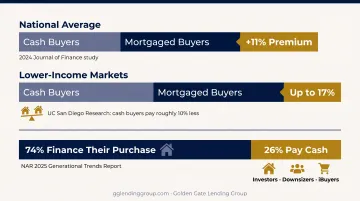
Here's where cash isn't automatically the winner. A peer-reviewed 2024 Journal of Finance study found that mortgaged buyers pay an average 11% premium compared to cash buyers. Researchers at UC San Diego describe this as cash buyers paying roughly 10% less. In some lower-income markets, that gap widened to as much as 17%.
Why the difference? Simple math. 74% of buyers nationally finance their purchase, according to NAR's 2025 Generational Trends report. More financed buyers means more competition, and more competition drives price up. Cash buyers, by contrast, are a smaller pool of investors, downsizers, and iBuyers who often price in a discount for the certainty they're providing.
What Is a Cash Offer?
An all-cash offer means the buyer pays the full purchase price upfront, using savings, investment accounts, or proceeds from a prior sale. No lender, no loan, no financing contingency.
For sellers, that simplicity translates into real benefits:
- Fewer showings and less disruption once an offer is accepted
- Less back-and-forth negotiation since there's no appraisal gap to worry about
- Lower stress from not wondering whether financing will fall apart at week five
That certainty comes down to who's actually behind the offer, and cash buyers come in different flavors. Some are individuals with significant liquid assets. Others are real estate investors or house flippers looking for value-add opportunities. iBuyers, like Opendoor and Offerpad, represent a growing segment, purchasing eligible homes directly and reselling them after repairs.
When Cash Offers Make the Most Sense
Cash offers tend to shine in specific situations:
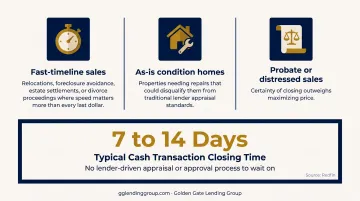
- Fast-timeline sales - relocations, foreclosure avoidance, estate settlements, or divorce proceedings where speed matters more than every last dollar
- As-is condition homes - properties needing repairs that could disqualify them from traditional lender appraisal standards
- Probate or distressed sales - where certainty of closing outweighs maximizing price
Redfin's guidance notes that cash transactions can often close in 7 to 14 days, largely because there's no lender-driven appraisal or approval process to wait on. That speed is exactly why cash appeals to sellers on a deadline.
What Is a Mortgage-Backed Offer?
A mortgage-backed offer is a purchase financed through a lender. The buyer has to qualify through credit review, income verification, and typically a home appraisal to confirm the property supports the loan amount.
For sellers, this route usually means:
- A larger buyer pool since most homebuyers rely on financing rather than sitting on liquid cash
- Higher potential sale prices because more competition means buyers push harder to win
- Built-in buyer vetting since lenders verify income and creditworthiness before the offer reaches you
Not all financed offers look the same. Conventional loans work for most price points, but jumbo loans kick in above the conforming limit, which FHFA set at $806,500 for most counties in 2025, rising to $1,209,750 in high-cost areas.
Some buyers also use bridge loans, like the equity-based financing Golden Gate Lending Group structures, to access equity from an existing property and compete more like a cash buyer while still technically financing.
When Mortgage Offers Make the Most Sense
Financed offers tend to win out when:
- The seller's top priority is maximizing sale price, not closing speed
- The buyer has a strong, verified pre-approval (not just a pre-qualification letter)
- The market is competitive enough that financed buyers are willing to bid above asking to beat out cash offers
That last point matters more than most sellers realize. In hot markets, sheer buyer volume can push financed offers past cash, even with the added contingencies.
Cash Offer vs. Mortgage: Which Is Better for Sellers?
There's no universal answer here. The right choice depends on how you weigh three things: timeline flexibility, risk tolerance, and the price gap you're willing to accept for certainty.
Choose the cash offer if:
- You need to close in weeks, not months
- You're selling as-is and want to avoid appraisal complications
- Certainty matters more to you than squeezing out the last few percentage points of value
Choose the mortgage-backed offer if:
- Maximizing sale price is your top priority
- The buyer has strong, verified pre-approval rather than a generic pre-qualification
- You're in a market where financed buyers are actively outbidding cash
Here's the part many sellers miss: not all mortgage offers carry the same risk. A buyer who's already completed pre-underwriting, or who's using bridge financing to eliminate a sale contingency, can close nearly as fast and as reliably as a cash buyer, without leaving money on the table.
This is where Golden Gate Lending Group fits into the picture. We specialize in owner-occupied bridge financing for Bay Area buyers, structuring loans that let qualified buyers submit stronger, more competitive offers on luxury properties without waiving financing entirely.
Instead of a contingent offer that depends on selling their current home first, our buyers move forward with equity-based bridge loans. This makes their financed offer look and act far more like cash.

This dynamic cuts both ways. If you accept a cash offer on your current home and need financing to move quickly on your next purchase, your own timeline can become the bottleneck. Working with a lender experienced in fast-moving, high-value transactions keeps that risk in check.
Conclusion
Neither offer type wins outright. Cash offers deliver speed and certainty; mortgage offers often deliver a higher price and a bigger pool of interested buyers. The "better" option is the one that matches what you actually need from this sale, whether that's a fast, clean exit or the highest possible number on the closing statement.
Rather than judging offers by financing type alone, look at the whole picture: net price after contingencies, how well-qualified the buyer really is, and the realistic closing timeline. Talk it through with your agent. If a buyer's financing structure raises questions, Golden Gate Lending Group can help you evaluate whether that offer is as strong as it looks on paper. We specialize in bridge financing for high-value California transactions.
Frequently Asked Questions
Is it better to pay cash or take a mortgage when buying a home?
It depends on the buyer's liquidity, investment goals, and how competitive the market is. This decision also shapes how attractive the offer looks to the seller on the other side.
Does a buyer with a mortgage count as a cash buyer?
No. A mortgage buyer's offer still depends on lender approval, which introduces risk a true cash offer doesn't carry. Strong pre-underwriting can narrow that gap significantly, though.
What is an all-cash deal?
An all-cash deal is a home purchase completed without any financing, using the buyer's own liquid funds to cover the full price. No lender or loan is involved in the transaction.
Are cash offers better for sellers?
Cash offers are often better for speed and certainty, since there's no financing contingency to worry about. However, they may come in below market value compared to a strong financed offer.
How much lower are cash offers than financed offers on average?
Research published in the Journal of Finance found mortgaged buyers pay roughly an 11% premium over cash buyers, meaning cash offers run about 10% lower on average. That gap varies by market and property type.
Should sellers always accept the highest offer regardless of financing?
Not necessarily. Contingencies, buyer qualification, and closing timeline all affect what an offer is really worth beyond the sticker price. A slightly lower, well-qualified offer can be the safer bet.