

Introduction
Picture this: you've found the perfect house in Pacific Heights, but your current home in Noe Valley hasn't sold yet. In San Francisco's competitive market, sellers routinely reject offers contingent on a buyer's home sale. That leaves you stuck between two homes and one bank account.
This timing gap is exactly what bridge loans solve. They're a specialized short-term financing tool that lets you tap your current home's equity before it sells, so you can move on a new purchase without waiting.
At Golden Gate Lending Group, we structure these loans daily for Bay Area buyers moving between luxury properties. This guide breaks down what a bridge loan actually is, how the process works step by step, what it costs, and when it makes sense for your situation.
Key Takeaways
- Bridge loans provide 3-12 month financing using your home's equity to buy before you sell
- Most lenders require 20%+ home equity and strong credit for approval
- Closing happens faster than a traditional mortgage, but rates and fees run higher
- Removing the sale contingency makes your offer far more competitive in hot markets
What Is a Bridge Loan?
A bridge loan, sometimes called a swing loan or gap loan, is short-term financing that lets you access equity in your current home before it sells. It "bridges" the gap between buying your next home and closing the sale on your old one.
Here's the core problem it solves: sellers want cash from their old home before committing to a new one, but buyers in fast-moving markets can't always wait around for that sale to close. This mismatch is precisely what bridge financing is built to fix.
What a bridge loan is NOT:
- A permanent mortgage replacement, since it's meant to be paid off within months
- The same product as a HELOC or home equity loan, despite all three using home equity as collateral
- A substitute for adequate savings or equity, since you still need a strong financial position to qualify
Even with alternatives like cash-out refinancing available, bridge loans stay relevant because they solve a timing problem that other products don't address directly. In fast-moving, high-value markets, sellers often won't even entertain a contingent offer.
Types of Bridge Loans
Lenders typically structure bridge loans one of two ways:
- Second-loan (piggyback) approach: The bridge loan sits alongside your existing mortgage as a second lien. You keep your current mortgage and use the bridge funds toward your new down payment.
- Single payoff loan: One larger bridge loan pays off your existing mortgage entirely, with remaining proceeds funding your new home's down payment.
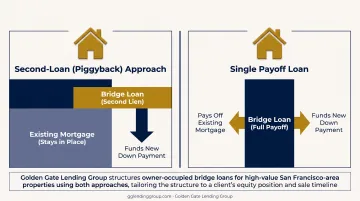
Golden Gate Lending Group structures owner-occupied bridge loans for high-value San Francisco-area properties using both approaches, tailoring the structure to a client's equity position and sale timeline rather than forcing a one-size-fits-all solution.
How Does a Bridge Loan Work?
A bridge loan moves through four stages: application and approval, fund disbursement, repayment, and final payoff. Each stage shapes your total cost and risk exposure.
Application and Approval
The process starts much like a traditional mortgage application. You'll submit proof of home equity, credit history, and debt-to-income (DTI) documentation.
Requirements vary widely by lender, but published benchmarks give a general sense of what's typical:
- Credit score: Bankrate reports many lenders want at least 680, while some require 740 or higher
- DTI ratio: Some lenders allow DTI as high as 50%
- Additional review items: Income, assets, and the equity available in your current home
Because bridge lending leans heavily on equity rather than income, approval criteria can differ dramatically between lenders. Always confirm specifics before assuming you qualify.
Fund Disbursement and Usage
Once approved, funds are typically disbursed as a lump sum. Borrowers use this toward:
- A down payment on the new home
- Closing costs
- Paying off the existing mortgage outright
Speed is one of the biggest advantages here. Bridge loan approval can happen in as little as 72 hours, with funding following in as little as two weeks, according to Rocket Mortgage. Compare that to a conventional mortgage, which typically takes 30 to 45 days to close. That speed difference is often the deciding factor for buyers competing against cash offers.
Repayment Structure and Risk Management
Bridge loans generally use one of three repayment structures:
- Interest-only payments during the loan term, followed by a balloon payoff
- Deferred payments, with everything due once the old home sells
- Lump-sum balloon payment at the end of the term, with no payments in between
Rates run higher than conventional mortgages because lenders are taking on short-term risk with an uncertain exit date. Bridge loan rates typically range from the prime rate up to prime plus 2 percentage points, per Bankrate. This premium reflects the compressed timeline and the lender's reliance on a future sale to trigger repayment.
Your current home secures the loan. If you can't repay when the term ends, whether through sale proceeds or another source, you risk foreclosure on that property. This is the single biggest structural risk in bridge financing, and it's why lenders scrutinize equity position so closely upfront.
Loan Payoff and Result
In the ideal scenario, your old home sells, generating proceeds that pay off the bridge loan in full. You're left with a single ongoing mortgage on your new property, just like any other homeowner.
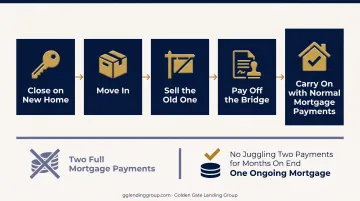
When timed well, a bridge loan simply disappears into the background of your transaction. You close on the new home, move in, sell the old one, pay off the bridge, and carry on with normal mortgage payments. No juggling two full mortgage payments for months on end.
When Should You Use a Bridge Loan?
Bridge loans perform best in specific scenarios:
- Competitive seller's markets where contingent offers get rejected routinely
- Relocations with tight timelines, such as a job transfer with a hard start date
- Investment renovations before resale, where investors need to quickly free capital tied up in an existing asset
In premium markets like San Francisco's most desirable neighborhoods, sellers often won't even consider a contingent offer. Removing the home-sale contingency can strengthen your position against cash buyers, according to an NAR interview with a Rocket Mortgage executive.
This is exactly the scenario Golden Gate Lending Group focuses on with owner-occupied bridge lending for $1M-$15M transactions across the Bay Area.
When it's less suitable:
- You're uncertain how long your current home will take to sell
- You lack a solid equity cushion (below 20% typically raises red flags)
- Your local market has slowed and days-on-market are stretching longer than your loan term
If any of these apply, a bridge loan can turn from a strategic tool into a financial squeeze.
Bridge Loan Costs, Qualification and Risks
Bridge loans come with real upfront costs, even given the short term. Expect:
- Origination fees
- Closing costs (often 1.5% to 3% of the loan amount, per Morgan Stanley)
- Appraisal fees
Combined, these typically add up to several thousand dollars regardless of how quickly the loan gets repaid.
Qualification depends more on equity than income. Golden Gate Lending Group, like most California bridge lenders, approves loans primarily on this basis.
Equity and LTV requirements:
| Requirement | Typical Benchmark |
|---|---|
| Minimum equity | 20%+ in current home |
| Maximum LTV | Up to 80% (some lenders go to 85%) |
| Minimum credit score | 680-740, lender-dependent |
The biggest risk remains straightforward: if your current home doesn't sell within the loan term, you still owe the full balance. Since the home secures the loan, foreclosure becomes a real possibility if you can't cover that balloon payment or find another repayment path. This is why lenders lean so heavily on equity position and realistic sale timelines during underwriting.
Bridge Loan Alternatives
Bridge loans aren't the only way to solve a buy-before-sell timing gap. A few other options worth knowing:
- Home equity loan: A lower-cost, longer-term option, but you'll carry two mortgages until your old home sells
- HELOC: Functions as a revolving credit line against your equity, often with better rates, though many lenders restrict or eliminate access once your home is listed for sale
- 80-10-10 piggyback loan: A second mortgage originated alongside your primary loan to cover the down payment gap, rather than borrowing against your existing home's equity
- Unsecured personal loans: An option for smaller gaps, though rates and limits are usually less favorable
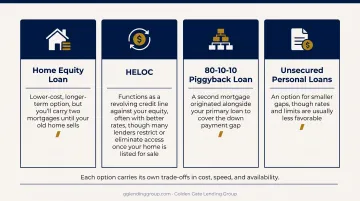
Each of these carries its own trade-offs in cost, speed, and availability. The right choice depends heavily on your equity position, timeline, and how competitive your local market is.
Frequently Asked Questions
What is a bridge loan and how does it work?
A bridge loan is a short-term loan that uses equity in your current home to fund a new purchase. You repay it, typically in a lump sum, once your old home sells.
How do you borrow a bridge loan?
Determine your available home equity, then find a lender offering equity-based bridge financing rather than income-based approval. Submit your documentation for pre-approval, which some lenders complete in as little as five minutes, with final funding usually arriving within days to a few weeks.
How much can you borrow on a bridge loan?
Loan amounts are generally tied to your equity and LTV ratio. Amounts range from tens of thousands of dollars up to seven figures, depending on the lender and property value.
What are typical bridge loan interest rates?
Rates run higher than conventional mortgages, often benchmarked at the prime rate plus a premium of up to 2 percentage points.
How do you repay a bridge loan?
Repayment typically comes from your old home's sale proceeds. Many loans require interest-only or deferred payments until that final lump-sum payoff.
What's the difference between a bridge loan and a HELOC?
A bridge loan is a lump-sum, fixed-term loan tied to a specific transaction. A HELOC is a revolving credit line, and it's often unavailable once your home is listed for sale.