

Zillow's 2024 seller survey found that 63% of sellers received at least one all-cash or no-financing-contingency offer — a clear sign that certainty, not just price, wins deals. Yet despite how often bridge loans get used to create that certainty, many buyers and business owners misunderstand how the financing is actually structured. That gap in understanding leads to mismatched loans, blown timelines, or missed opportunities.
This guide breaks down exactly how bridge financing works, step by step, not just what it means in theory.
Key Takeaways
- Bridge financing closes the gap between a new purchase and a pending sale or refinance
- The process unfolds in four stages: equity qualification, funding, interim repayment, and payoff
- Homebuyers, investors, and businesses use bridge loans to access capital quickly
- Expect higher rates and fees than conventional loans, in exchange for speed and leverage
What Is Bridge Financing?
Bridge financing is short-term funding that "bridges" the gap between a current funding need and the arrival of permanent financing or sale proceeds. It solves a timing mismatch, not a shortage of assets.
That mismatch shows up in two common forms:
In real estate, a homeowner wants to buy a new property before their current one sells, but can't access the equity tied up in that home until closing.
In business, a company needs capital now, before a funding round closes or a loan tranche is disbursed, to cover payroll, acquisition costs, or IPO-related expenses.
Bridge financing is not a replacement for a permanent mortgage, and it's distinct from a HELOC or standard second mortgage. A HELOC is reusable, open-end credit against home equity, with a draw period followed by a longer repayment period, usually at a variable rate.
A bridge loan, in contrast, is transaction-specific: short-term, tied to a single purchase, and built around a defined payoff rather than ongoing use.
That transaction-specific structure is exactly why bridge financing remains preferred in competitive, high-value markets: it lets buyers submit offers without a sale contingency, a structural advantage sellers weigh heavily when comparing bids.
Types of Bridge Financing
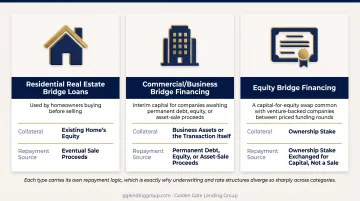
Not all bridge loans work the same way. The mechanics (collateral, repayment source, and typical rate structure) shift depending on who's borrowing:
- Residential real estate bridge loans: Used by homeowners buying before selling. Collateral is typically the existing home's equity; repayment comes from the eventual sale proceeds.
- Commercial/business bridge financing: Interim capital for companies awaiting permanent debt, equity, or asset-sale proceeds, often secured by business assets or the transaction itself.
- Equity bridge financing: A capital-for-equity swap common with venture-backed companies between priced funding rounds. The "payoff" here isn't a sale: it's an ownership stake exchanged for capital.
Each type carries its own repayment logic, which is exactly why underwriting and rate structures diverge so sharply across categories.
How Does Bridge Financing Work?
Bridge financing moves through a defined sequence: application, structuring, monitoring, and payoff. Each stage shapes the loan's final cost and speed.
Application & Qualification
The process starts when a borrower applies, submitting financial documents, credit history, and details on existing property equity or expected incoming funds. Qualification here is underwriter-driven, not automated. Most conventional banks won't touch these loans, so borrowers typically work with a lender that specializes in bridge financing.
The common bottleneck is equity and credit strength. Published benchmarks vary by lender: Experian cites 700+ FICO scores and up to 80% combined loan-to-value as common thresholds, while other sources note minimums closer to 680 with 15-20% equity required.
Golden Gate Lending Group takes an equity-based approach rather than an income-based one. The qualification conversation centers on how much equity sits in the current property, not tax returns or W-2s.
Loan Structuring & Disbursement
Once qualified, the lender calculates a loan amount based on combined loan-to-value across the current and new property, then structures the loan as either a lump sum or a line of credit.
Funds typically get released to cover:
- The down payment on the new purchase
- Closing costs on the transaction
- Sometimes, the existing mortgage balance rolled into the new loan
Funding speed varies enormously by lender. Specialized lenders, such as Golden Gate Lending Group, which structures owner-occupied bridge loans from $1 million to $15 million for San Francisco's luxury market, can tailor terms for complex, high-value transactions faster than conventional institutions bound by standardized underwriting.
Repayment & Risk Monitoring
Bridge loans manage risk over their term through one of three structures: interest-only payments, deferred payments, or a scheduled balloon payment at maturity.
Because repayment usually depends on the borrower's existing property selling, lenders often track listing status or sale progress as an ongoing loan condition. This isn't just paperwork. Missed payments or a stalled sale risk foreclosure on the pledged collateral property, so lenders stay engaged with the timeline rather than disbursing funds and walking away.
Payoff & Outcome
The result: the borrower completes the new purchase or meets the business need without waiting on the original sale or funding round to close first.
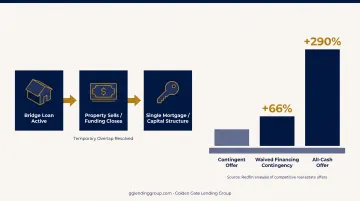
Once the existing property sells (or the funding round closes), those proceeds pay off the bridge loan in full. The borrower then transitions to a single long-term mortgage or capital structure, and the temporary overlap disappears.
That non-contingent positioning has measurable value. Waiving the financing contingency carried 66% higher odds of winning a bidding war, while all-cash offers, which bridge financing effectively mimics, carried 290% higher odds of winning, according to Redfin's analysis of competitive offers. For buyers competing against multiple offers, that structural edge often decides who gets the keys.
Who Uses Bridge Financing
Bridge financing serves three main groups, each solving a different timing problem:
- Homebuyers: Purchasing a next home before selling the current one — common among relocating families or those upgrading to a larger property who don't want to rent in between moves.
- Real estate investors: Financing the acquisition or renovation of an investment or multi-unit property before permanent financing or resale.
- Businesses: Covering short-term operating costs like payroll or IPO-related expenses while awaiting a funding round or a delayed loan tranche.
In high-value, fast-moving markets like the San Francisco Bay Area, bridge financing carries outsized value. Competing on luxury listings without a sale contingency often decides who wins the property.
Golden Gate Lending Group focuses on exactly this scenario, structuring equity-based owner-occupied loans for buyers who need to move fast on a home they can't afford to lose.
Weighing the Pros, Cons & Costs of Bridge Financing
Bridge loans solve a real problem, but they come with tradeoffs worth weighing before signing anything.
Benefits:
- Faster closings than conventional mortgage underwriting allows
- No sale contingency required, which strengthens your offer
- Stronger negotiating position against competing bids
- Flexible repayment options, including interest-only or deferred structures
Drawbacks:
- Higher interest rates than conventional mortgages, often several percentage points above standard fixed rates
- Added origination and closing fees on top of that rate premium
- Risk of carrying two payments simultaneously if the sale takes longer than expected
When it makes sense: Bridge loans work best when you need speed and certainty — competing on a listing, avoiding a rental gap, or funding a business need before permanent capital arrives. A HELOC, cash-out refinance, or personal loan may be more cost-effective if you have months, not weeks, to work with and don't need non-contingent offer strength.
Conclusion
Bridge financing follows a clear working logic: qualify equity, disburse funds, manage interim risk, then repay via sale or funding proceeds. Understanding that cycle, not just the definition, is what separates a well-structured loan from a costly mismatch.
Working with an experienced bridge lender matters here. Golden Gate Lending Group has funded more than $1 billion in loans, structuring bridge financing from $1M to $15M for California homeowners and investors navigating San Francisco's luxury market.
Frequently Asked Questions
Is bridge financing a good idea?
It depends on whether you can comfortably carry two payments temporarily and how competitive your market is. Buyers who need to move fast without a sale contingency often find it worth the cost, though it's not right for every situation.
Who typically uses bridge financing?
Homeowners moving before selling their current property, real estate investors financing acquisitions or renovations, and businesses awaiting long-term funding all rely on bridge loans to close timing gaps.
What is the difference between a bridge loan and a HELOC?
A bridge loan is short-term, transaction-specific financing disbursed as a lump sum or line of credit tied to one purchase. A HELOC is longer-term, reusable credit against home equity with a draw period and separate repayment period.
How much does a bridge loan typically cost?
Expect an interest rate premium over conventional mortgage rates, plus origination and closing fees. Exact costs vary by lender, loan size, and market, so getting a specific quote matters more than relying on general ranges.
How quickly can you close on a bridge loan?
Residential bridge loans often close in 15 to 30 days, compared to 30 to 45 days for a standard mortgage closing. Specialized, equity-based lenders can sometimes move even faster on well-qualified deals.
What credit score or equity is needed to qualify for a bridge loan?
Published benchmarks vary, but many lenders look for credit scores in the high 600s to 700+ range, with combined loan-to-value typically capped around 80%. Equity-based lenders like Golden Gate Lending Group prioritize available equity over credit history, opening doors for non-traditional borrowers.