
Introduction
Building or buying a luxury home in the Bay Area rarely fits neatly into a standard 30-year mortgage timeline. Between land acquisition, ongoing construction costs, and the gap that opens when your current home hasn't sold yet, many buyers and builders need capital fast. Conventional lenders simply can't move quickly enough to fill it.
This is the core challenge: you need flexible, short-term financing that bridges land purchase, construction costs, or a sale-and-purchase timing mismatch — often in weeks, not months.
This guide breaks down what interim loans actually are and how draws and repayment typically work. It also covers what rates and fees to expect, plus how to choose a lending partner who understands San Francisco's unique permitting timelines and property values.
Key Takeaways
- An interim loan bridges the gap until permanent financing, a sale, or new capital arrives
- Terms run from a few weeks to two years, with interest-only payments throughout
- Rates run higher than standard mortgages due to short duration and added lender risk
- Construction funds release in draws tied to milestones, not as a single lump sum
- Golden Gate Lending Group offers equity-based approval for high-value Bay Area purchases
What Is an Interim Loan?
An interim loan is short-term financing used to bridge a funding gap until permanent financing, a property sale, or expected capital becomes available.
The CFPB's guidance on bridge loans under 12 months covers two common scenarios: buying a new home before selling your current one, or financing a dwelling's initial construction.
These loans are secured by real estate and go by several names depending on the use case: bridge loan, construction loan, or simply interim financing. Repayment is typically due as a single lump sum once the permanent loan closes, sale proceeds arrive, or other capital comes through.
Interim Loans vs. Traditional Mortgages
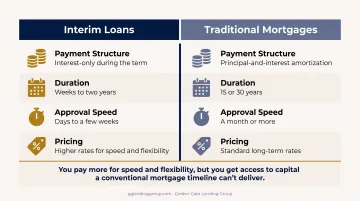
Traditional mortgages amortize principal and interest over 15 or 30 years. Interim loans work differently:
- Payment structure: Interest-only during the term, versus principal-and-interest amortization
- Duration: Weeks to two years, versus decades
- Approval speed: Often days to a few weeks, versus a month or more for conventional underwriting
- Pricing: Higher rates reflecting the lender's shorter window and added risk exposure
The tradeoff is straightforward. You pay more for speed and flexibility, but you get access to capital a conventional mortgage timeline can't deliver.
Interim Loan, Construction Loan & Bridge Loan: Clarifying the Terms
"Interim loan" functions as an umbrella term. Two specific products fall underneath it:
A construction loan funds the actual costs of building: labor, materials, and permits. A bridge loan specifically bridges the gap between selling one property and purchasing another.
Golden Gate Lending Group's specialty sits squarely in the second category. Their owner-occupied bridge financing addresses San Francisco buyers who need to close on a new home before their current one sells, one of the most common interim financing needs in the region.
How Interim Construction Loans Work
A construction lender commits to a total loan amount based on your project budget and the projected completed value of the home. Rather than handing over the full sum upfront, funds release in draws as construction milestones are verified — foundation poured, framing complete, roof on, and so forth.
This structure matters for your monthly costs. Interest accrues only on funds actually disbursed at each stage, not the full committed amount. If you've drawn $400,000 of a $1.5M commitment, you're paying interest on $400,000.
Before releasing each draw, most lenders require:
- Site inspection confirming the milestone was actually completed
- Lien waivers from contractors and subcontractors, protecting the lender's first-lien position
- Title endorsement verifying no new liens have attached to the property
One-Time Close vs. Two-Time Close Construction Loans
This decision shapes your flexibility for the entire project.
| Feature | One-Time Close | Two-Time Close |
|---|---|---|
| Closings required | One | Two (construction, then permanent) |
| Paperwork | Simpler, single closing | More documentation overall |
| Rate lock | Set at initial closing | Re-determined at second closing |
| Flexibility on cost changes | Limited | Higher — can resize loan amount |
| Best for | Predictable budgets | Projects with uncertain final costs |
A one-time close bundles construction and permanent financing into a single transaction. It's simpler, but if your budget shifts significantly mid-build, you have less room to adjust. A two-time close requires refinancing into a separate permanent mortgage once construction wraps, which costs you a second approval process but buys flexibility to resize the loan.
Handling Delays, Extensions & Over-Budget Projects
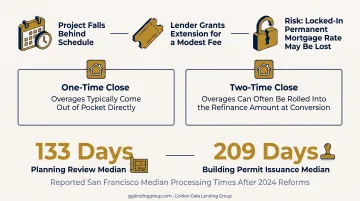
Construction rarely runs exactly on schedule. Most lenders will grant an extension for a modest fee if your project falls behind. There's a catch, though: extending your construction loan can mean losing a previously locked-in permanent mortgage rate.
Going over budget plays out differently depending on your closing structure. With a one-time close, overages typically come out of your pocket directly. With a two-time close, overages can often be rolled into the refinance amount at conversion.
Budget overages aren't the only variable, though: permitting delays create the same extension pressure, and they often surface before construction even begins. San Francisco's median processing times reportedly ran 133 days for Planning review and 209 days for building permit issuance after 2024 reforms. If your loan term doesn't account for pre-construction delays as well as build time, you may find yourself requesting an extension before the first shovel hits dirt.
Interim Loan Interest Rates, Fees & Monthly Payments
Interim and construction loan rates run higher than long-term mortgage rates. National data from AAPL's Lightning Docs shows business-purpose bridge loans averaging 10.83% in January 2025, with most falling between 9% and 12.99%. That's well above the roughly 6.7% Freddie Mac reported for conventional 30-year mortgages during the same period.
This spread reflects the lender's shorter horizon and higher risk profile. It's not a direct quote for California luxury properties, but it's a useful benchmark.
Monthly payments during the interim term are almost always interest-only, calculated against the amount drawn to date rather than your full loan commitment.
What Drives Your Pricing
Several factors shape the rate and terms you'll actually be quoted:
- Loan amount and overall deal size
- Borrower credit profile and financial documentation
- Loan-to-value ratio and available equity
- Project complexity: a custom luxury build costs more to underwrite than a standard renovation
Beyond the Interest Rate
Budget for these additional costs on top of your rate:
- Origination or processing fees
- Appraisal costs
- Draw inspection fees at each milestone
- Potential extension fees if the timeline slips
Once the interim period ends, repayment works differently than a typical mortgage. The full balance is due as a lump sum at maturity, when the loan converts to permanent financing or the property sells. Terms generally range from a few weeks up to roughly two years, depending on the project's scope or the expected funding event.
Many lenders allow early payoff without penalty once permanent financing or sale proceeds land. That's worth confirming upfront, since paying off early can substantially reduce your total interest cost.
Common Uses of Interim Loans in Bay Area Real Estate
Interim financing shows up across several distinct scenarios in this market:
- Ground-up construction or major renovation of luxury custom homes in premier San Francisco neighborhoods, where build timelines and permitting complexity demand patient, draw-based funding
- Buy-before-sell bridge financing for homeowners purchasing a new property before their current one closes — the core specialty Golden Gate Lending Group provides for owner-occupied transitions in neighborhoods like Pacific Heights and Noe Valley
- Acquisition and rehab financing for investors purchasing multi-unit or investment properties ahead of securing long-term financing
That second scenario deserves a closer look, because it's the one Bay Area buyers hit most often. Picture a homeowner with $1.7M in equity sitting in a current home worth $2M, trying to close on a $2.2M purchase before their existing property sells.
A bridge loan unlocks that trapped equity for the down payment, letting them move once instead of into a rental in between. That's a distinct problem from funding a construction draw schedule, even though both fall under the "interim loan" umbrella.
Choosing the Right Interim Lending Partner for Your Bay Area Project
National lenders often struggle with San Francisco's permitting timelines, zoning complexity, and property values that don't fit standard underwriting boxes. Local expertise directly affects whether a deal closes on time or falls apart entirely.
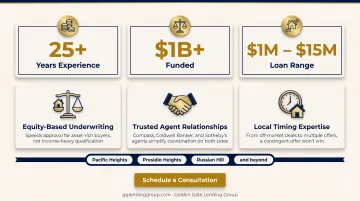
Golden Gate Lending Group brings more than 25 years of mortgage lending experience and has funded over $1 billion in loans across California's luxury market.
The firm structures owner-occupied bridge and interim financing from $1 million to $15 million, specifically for buyers navigating San Francisco's most competitive neighborhoods, including Pacific Heights, Presidio Heights, Russian Hill, and beyond.
What sets this kind of specialist apart:
- Equity-based underwriting rather than income-heavy qualification, which speeds up approval for asset-rich buyers
- Trusted relationships with agents at Compass, Coldwell Banker, and Sotheby's simplify coordination on both sides of a transaction
- Familiarity with local timing pressures, from off-market deals to multiple-offer situations where a contingent offer simply won't win
These advantages matter most when timing is tight. If you're weighing a buy-before-sell purchase or trying to unlock equity trapped in a current property, a direct conversation beats guessing at generic online calculators. Schedule a consultation with Golden Gate Lending Group to walk through your specific timing, equity position, and target neighborhood.
Frequently Asked Questions
What is an interim loan?
An interim loan is short-term financing that bridges a funding gap until permanent financing, a property sale, or other expected capital becomes available. It's commonly used for construction costs or the timing gap between selling one home and buying another.
What are the typical interest rates and monthly payments for interim loans?
Rates run higher than long-term mortgage rates, often in the high-single to low-double digits depending on risk profile. Monthly payments are usually interest-only, calculated on funds actually disbursed rather than the full loan amount.
How long does an interim loan typically last?
Terms usually range from a few weeks up to about two years, depending on your construction timeline or the expected funding event, such as a sale closing or permanent loan approval.
Can I get an extension on my construction loan if the project runs behind schedule?
Most lenders will grant an extension for a modest fee if your project falls behind. Just be aware this can put a previously locked-in permanent mortgage rate at risk.
What happens if my construction project goes over budget?
With a one-time close loan, you typically cover the overage out of pocket. With a two-time close loan, the overage can often be rolled into the amount you refinance at completion.
How is an interim loan different from a bridge loan?
"Interim loan" is the broader umbrella term covering any short-term financing that bridges a funding gap. "Bridge loan" specifically refers to financing the gap between selling one property and purchasing the next.