

A bridge loan closes that gap. But "bridge loan for seniors" isn't one product. It's actually two very different loan types, and mixing them up can send you to the wrong lender entirely.
Lenders typically require around 20% home equity before approving a residential bridge loan, according to Bankrate. This guide walks through both bridge loan types, what they cost, how to qualify, and which alternatives might fit your situation better.
Key Takeaways
- Bridge loans offer short-term financing, usually 6-12 months, until permanent funding arrives.
- Seniors typically choose a real estate purchase bridge loan or a senior-living/care bridge loan.
- Costs include an interest rate plus origination fees for the loan term.
- Qualification depends on home equity, credit history, and a solid repayment plan.
- HELOCs, reverse mortgages, and rent-back agreements offer alternatives depending on timing and goals.
What Is a Bridge Loan for Seniors?
A bridge loan is short-term financing, usually secured by the borrower's current home, designed to provide cash before permanent funding shows up. That permanent funding could be a home sale, an insurance payout, or approved benefits.
Most bridge loans run 6-12 months and get repaid in one lump sum once the permanent funding source lands. Some lenders offer terms as short as three months for smaller, faster-moving deals.
Two Main Types of Bridge Loans for Seniors
The confusion around this term usually comes down to scale and purpose. Here's how the two products differ:
| Feature | Real estate purchase bridge loan | Senior-living/care bridge loan |
|---|---|---|
| Purpose | Buy a new home before the current one sells | Cover move-in fees and rent while awaiting other funds |
| Typical size | $1 million to $15 million for luxury owner-occupied purchases | $5,000 to $500,000 |
| Collateral | Secured by home equity | Often lightly secured or unsecured |
| Common use case | Downsizing, relocating closer to family, buying single-story homes | Assisted living, memory care, or nursing-home costs |
Real estate purchase bridge loans let a senior buy their next home (a single-story property, a place near their kids, or a downsized residence) before the current house sells. Golden Gate Lending Group specializes in structuring these owner-occupied bridge loans, typically from $1 million to $15 million, for California seniors relocating or downsizing within the Bay Area's competitive luxury market.
Senior-living/care bridge loans cover the smaller, ongoing costs of a transition into care. ElderLife Financial, a specialty lender in this space, advertises a range of $5,000 to $500,000 for its own product; that figure reflects one lender's example, not an industry-wide standard.
The key distinction: one type helps you buy property. The other helps you pay for ongoing living or care expenses while waiting on other money.
How Do Bridge Loans for Seniors Work?
For real estate-secured bridge loans, your current home's equity typically serves as collateral. Most lenders want to see roughly 20% equity remaining in that home before approving the loan.
The process generally unfolds in four stages:
- Application and pre-qualification: Submit basic financial details and property information to get a preliminary approval.
- Appraisal and underwriting: For real estate-secured loans, an appraiser confirms your home's value and the lender reviews credit, income, and equity.
- Fund disbursement: Money moves to escrow or directly to the senior living community, depending on loan type.
- Repayment: Interest-only payments during the term, followed by a lump-sum payoff when your home sells or benefits arrive.
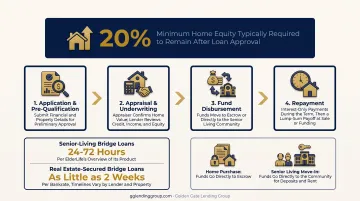
Approval speed varies widely by loan type. Senior-living bridge loans can fund within 24-72 hours in some cases, according to ElderLife's overview of its product.
Real estate-secured bridge loans take longer because they involve appraisal and title work. Bankrate notes some residential bridge loans can close in as little as two weeks, though timelines depend heavily on the lender and property.
Funds get disbursed differently depending on what you're financing:
- Home purchase: Money goes directly to escrow to complete the transaction.
- Senior living move-in: Funds go straight to the community for deposits and monthly rent.
Most bridge loans require interest-only payments throughout the term. The principal comes due as a single balloon payment once your old home sells or your permanent funding arrives, rather than being paid down gradually like a traditional mortgage.
Interest Rates, Fees & Typical Costs
Bridge loan pricing depends heavily on loan type, size, and your credit profile, so treat any published range as a benchmark rather than a quote.
Interest rates: Bankrate frames residential bridge loan rates as running from prime to roughly prime plus 2 percentage points. Separately, LendingTree reports a broader range of 6% to 12% for residential bridge products, with your exact rate shaped by credit score, loan amount, and loan-to-value ratio.
Closing costs and fees: LendingTree puts typical closing costs and fees at 1% to 3% of the loan amount. These can differ between real estate-secured loans (which involve appraisal and title fees) and senior-living loans (which are often structured more like a line of credit with lighter documentation). Golden Gate Lending Group's equity-based approval process reflects this lighter-documentation model, since qualification depends primarily on home equity rather than income verification.
Here's a quick way to estimate monthly affordability. At a representative 8% annual rate, interest-only payments work out to:
$1,000 borrowed × 0.08 ÷ 12 = $6.67 per month, per $1,000 financed.
So on a $500,000 bridge loan at 8%, you'd budget roughly $3,335 per month in interest-only payments — before any principal repayment, which arrives later as a lump sum.
This calculation excludes origination fees, appraisal costs, and escrow charges, all of which add to your total cost of borrowing.
How Do You Qualify for a Bridge Loan as a Senior?
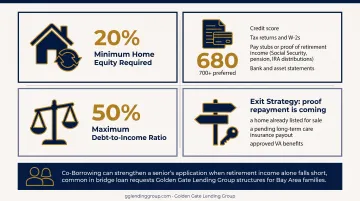
Qualification centers on four things: home equity, credit and documentation, debt-to-income ratio, and a believable exit plan.
Home equity. Lenders generally want to see at least 20% equity in your current home before approving a real estate-secured bridge loan. This protects the lender if your home takes longer than expected to sell.
Credit and documentation. Expect lenders to review:
- Credit score (often 680 or higher, with some lenders preferring 700+)
- Tax returns and W-2s
- Pay stubs or proof of retirement income (Social Security, pension, IRA distributions)
- Bank and asset statements
Debt-to-income ratio. Many lenders allow DTI up to around 50% for bridge loan approval, though this varies by lender and loan size. A higher DTI can still work if your equity position is strong.
Exit strategy. This is the most important factor. Lenders want proof that repayment is coming — a home already listed for sale, a pending long-term care insurance payout, or approved VA benefits. Without a clear exit plan, approval gets much harder.
Beyond these four core factors, one more strategy can tip the scales: co-borrowing. Adding an adult child or family member to the application can strengthen a senior's case, particularly when retirement income alone doesn't meet a lender's thresholds. This is common in real estate bridge loan requests that Golden Gate Lending Group structures for Bay Area families, where a family member's income or credit profile helps round out the application.
What Are the Alternatives to Bridge Loans for Seniors?
A bridge loan isn't always the right tool. Depending on your timeline and goals, one of these alternatives might fit better:
- HELOC (Home Equity Line of Credit): Revolving credit secured by your home, letting you borrow, repay, and borrow again without a fixed short-term deadline. Rates are typically variable.
- Reverse mortgage (HECM): Available to homeowners 62 and older, with no monthly payment required as interest and fees accrue against the balance. Repayment triggers when you move out or pass away, not on a fixed schedule.
- Personal or family loans: A lower-commitment option for smaller funding gaps. Family loans avoid institutional underwriting entirely, though the Consumer Financial Protection Bureau recommends putting repayment terms in writing to avoid confusion later.
- Contingent offers or rent-back agreements: Skip financing entirely by timing your sale and purchase through contract terms. A home-sale contingency gives you time to sell first, while a rent-back lets you stay in your sold home temporarily after closing.
Each option works best in a different situation. A HELOC offers ongoing flexibility, a reverse mortgage suits seniors staying put long-term, family loans work well for smaller amounts, and contract terms give sellers room to negotiate.
Frequently Asked Questions
What are the typical interest rates and fees for bridge loans for seniors?
Rates typically run from prime to about prime plus 2 points on residential bridge loans, with broader published ranges of 6-12% depending on the lender. Closing costs and fees generally fall between 1-3% of the loan amount, varying by lender and loan type.
How do you qualify for bridge loans as a senior?
Lenders look at home equity (often around 20%), credit score (typically 680+), and income documentation like tax returns and pay stubs. They also want a clear exit strategy, such as a listed home or pending benefits.
What are the alternatives to bridge loans for seniors?
HELOCs and reverse mortgages let you access equity without a short repayment deadline. Personal or family loans suit smaller gaps, while contingent offers or rent-back agreements can avoid financing entirely.
How long does it take to get approved for a bridge loan?
Senior-living bridge loans can approve and fund within 24-72 hours in some cases. Real estate-secured bridge loans typically take longer due to appraisal and title work, though some lenders can close in as little as two weeks.
Is a bridge loan the same as a reverse mortgage?
No. A bridge loan is short-term financing repaid once your home sells or benefits arrive. A reverse mortgage is long-term, with no required monthly payments, and is repaid when you move out or pass away.
Can a bridge loan help a senior buy a new home before selling their current one?
Yes. Real estate-secured bridge loans, like those Golden Gate Lending Group structures for Bay Area seniors, use existing home equity to fund a new purchase upfront. The loan gets repaid once the original home sells.