
Introduction
Picture this: you've just walked through your dream home in Pacific Heights. Bay windows, a view of the Golden Gate, and a price tag that won't wait around while you sell your current place.
The seller wants a clean offer. Your equity is locked up in a house that hasn't hit the market yet.
This timing gap is exactly what private money bridge loans solve. These are short-term, asset-based loans from non-bank lenders that let you tap your home equity now, so you can buy before you sell.
Unlike a traditional mortgage, approval hinges on your property's value, not months of income documentation. In San Francisco's competitive luxury market, that speed can mean the difference between landing the house and losing it.
This guide breaks down how private bridge loans work, who qualifies, how much you can borrow, and how they stack up against bank-issued bridge financing.
Key Takeaways
- Approval is based on equity, not income or credit score
- Closings can happen in days to two weeks, much faster than banks
- Loan amounts typically cap at 65%-70% LTV of your home's value
- Expect higher rates and fees in exchange for speed and easier qualification
- Best suited for short-term transitional needs with a clear repayment plan
What Are Private Money Bridge Loans?
A private money bridge loan is short-term financing from a private or hard money lender, secured by real estate equity. It's designed to bridge the financial gap between buying a new property and selling your current one.
The core difference from bank bridge loans comes down to underwriting priorities:
| Lender Type | Underwriting Focus |
|---|---|
| Private lenders | Emphasize collateral value and equity position first |
| Banks | Require extensive credit history, income documentation, and debt-to-income (DTI) review |
That's not to say private lenders ignore your finances entirely. Most still want to see a workable exit strategy and basic transaction feasibility. But the emphasis shifts heavily toward what your property is worth, not just what your pay stubs say.
Who Uses Private Money Bridge Loans
The typical borrower doesn't fit neatly into a conventional bank's checklist. Common profiles include:
- Luxury homebuyers upgrading or relocating within competitive Bay Area neighborhoods
- Real estate investors acquiring multi-unit properties on a tight timeline
- Self-employed or high-net-worth individuals whose income is harder to document through W-2s and tax returns alone
If your financial picture is complex but your equity is strong, a private bridge loan often opens doors a bank simply can't. These borrowers often have significant equity or investment capital, and loan amounts commonly range from $1 million to $15 million to match higher price points in luxury and investment markets.
Common Uses of Private Bridge Financing
Borrowers turn to private bridge loans for several core scenarios:
- Purchasing a new home before the current one sells
- Funding light renovations to boost a listing's sale price
- Acquiring investment or multi-unit properties quickly
- Competing against cash buyers in hot markets like San Francisco
That last point matters more than it might seem. In San Francisco, 26.5% of home purchases in 2024 were made entirely in cash, according to Redfin's county-record analysis. A bridge loan lets you make an offer that competes on that same footing, without draining your savings.
How Do Private Money Bridge Loans Work?
The process moves faster than conventional financing because it skips the deep dive into income history. Here's the general flow:
- Apply with basic property and equity details
- Property evaluation — the lender assesses your existing home's value and condition
- Approval, often within days once equity and exit strategy check out (Golden Gate Lending Group can often issue pre-approvals in under 5 minutes)
- Funding, so you can close on the new property
- Repayment upon sale or refinance of your existing home

Loan Amounts and Cross-Collateralization
Your borrowing power is determined by the loan-to-value (LTV) ratio on your current property. Some private lenders also allow cross-collateralization, meaning you can pledge more than one property to increase what you can borrow. This is particularly useful for owners with equity spread across multiple homes.
Terms and Repayment Structure
Private bridge loans typically run:
- 6 months to 2 years in duration
- Interest-only during the term
- With a balloon payment due at sale or refinance
Rates and the Role of Exit Strategy
Rates run higher than a bank mortgage because of the speed, shorter duration, and equity-based risk model. For example, a 2025 pricing guide from FCTD shows a low-leverage first-mortgage bridge loan priced around 10% interest plus two points for individual trust-deed investors. Actual pricing varies by lender, leverage, and property specifics.
Because private lenders skip heavy income documentation, they lean hard on your exit strategy. Selling your current home or securing a refinance is the repayment plan, so lenders scrutinize that path closely even without asking for tax returns.
Who Qualifies and How Much Can You Borrow?
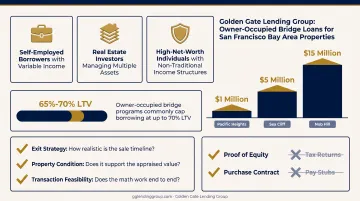
Qualification centers on home equity, not your credit score or DTI ratio. That's what makes private bridge loans accessible to:
- Self-employed borrowers with variable income
- Real estate investors managing multiple assets
- High-net-worth individuals with non-traditional income structures
LTV thresholds matter here. Owner-occupied bridge programs commonly cap borrowing at up to 70% LTV of the existing property's appraised value, though caps vary by lender and program. Many private lenders in this space work within a similar 65%-70% LTV range.
Borrowing limits scale with property value. Golden Gate Lending Group, for instance, specializes in owner-occupied bridge loans from $1 million to $15 million for San Francisco Bay Area properties, reflecting the luxury price points common in neighborhoods like Pacific Heights, Sea Cliff, and Nob Hill.
Beyond equity, private lenders still weigh:
- Exit strategy strength: How realistic is the sale timeline?
- Property condition: Does it support the appraised value?
- Overall transaction feasibility: Does the math work end to end?
Once those numbers check out, documentation stays light compared to a bank loan. Expect to provide proof of equity and a purchase contract, not stacks of tax returns and pay stubs.
Private Money Bridge Loans vs. Traditional Bank Bridge Loans
Both loan types bridge the same timing gap, but the path there looks different.
| Factor | Private Money Bridge Loan | Traditional Bank Bridge Loan |
|---|---|---|
| Underwriting focus | Property equity | Credit, income, DTI |
| Approval speed | Days to two weeks | Several weeks |
| Loan term | 6 months to 2 years | Varies, often shorter-term |
| Rates and fees | Higher | Generally lower, but stricter to qualify |
| Documentation | Proof of equity, purchase contract | Tax returns, pay stubs, credit review |
When speed and flexibility matter more than getting the lowest possible rate, a private lender makes sense. This is especially true in a bidding war, where a bank's multi-week timeline could cost you the house. Golden Gate Lending Group, for instance, evaluates approvals mainly on property equity, often delivering pre-approval within five minutes.
If you already have a strong banking relationship and time isn't a pressing constraint, a traditional bank bridge loan might work fine.
The trade-off is straightforward: pay more for speed and flexible qualification, or wait longer for a potentially cheaper loan that demands more paperwork.
Pros, Cons, and Choosing the Right Lender
Advantages of Private Money Bridge Loans
- Fast funding — often within days once equity and exit strategy are confirmed
- Flexible underwriting based on collateral value, not income documents
- Non-contingent offers possible, which carries real weight in competitive markets like San Francisco
- Self-employed and investor-friendly, accommodating borrowers who don't fit conventional lending boxes
Potential Drawbacks to Consider
- Higher interest rates and fees compared to conventional bank financing
- Carrying two properties and two mortgage payments is possible if your current home doesn't sell quickly
- A realistic exit strategy is critical when repayment windows are short
If your current home lingers on the market longer than expected, that balloon payment doesn't wait. Go in with a grounded sale timeline, not a hopeful one.
Why Work With Golden Gate Lending Group
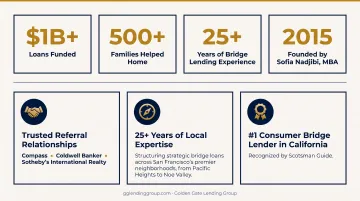
Given these tradeoffs, choosing an experienced lender matters as much as the loan terms themselves. Golden Gate Lending Group specializes in owner-occupied private bridge financing for Bay Area luxury properties. Founded in 2015 by Sofia Nadjibi, MBA, the firm has funded over $1 billion in loans and helped more than 500 families move into their next home without waiting on a sale first.
A few things set the firm apart:
- Trusted referral relationships with agents at Compass, Coldwell Banker, and Sotheby's International Realty
- Sofia Nadjibi's 25+ years structuring strategic bridge loans across San Francisco's premier neighborhoods, from Pacific Heights to Noe Valley
- Recognition as the #1 Consumer Bridge Lender in California by Scotsman Guide
For homeowners weighing a non-contingent offer against the fear of juggling two mortgages, that kind of specialized, equity-focused lending can be the deciding factor.
Frequently Asked Questions
Is a private money bridge loan ever a good idea?
Yes, particularly if you need speed, flexibility, or don't fit traditional bank criteria. Just make sure you have a solid exit strategy, since the higher costs only pay off if your current home sells on schedule.
Can I borrow from a private lender for a bridge loan?
Absolutely. Private and hard money lenders specialize in this exact financing type, evaluating your property equity rather than leaning heavily on credit scores or income documentation.
How much can you borrow with a private money bridge loan?
Borrowing amounts are typically based on LTV, often up to 65%-70% of your existing home's equity. Luxury-focused lenders like Golden Gate Lending Group structure loans from $1 million to $15 million.
Who qualifies for a private money bridge loan?
Qualification centers on sufficient home equity and a clear repayment or exit strategy. This makes the loans accessible to self-employed borrowers and investors who might struggle with conventional underwriting.
What is the interest rate on a private money bridge loan?
Rates run higher than bank loans due to the short-term, equity-based risk model. Individual lenders often price these loans around 10% plus origination points, though your actual rate depends on leverage and loan specifics.
How fast can you close a private money bridge loan?
Private bridge loans can often close within days to about two weeks, compared to the several weeks typically required for conventional bank financing.