
Introduction
San Francisco's median home price climbed to roughly $1.8 million in November 2025, up from $1.6 million just a year earlier. That's a jump of more than $40,000 in the cash needed for a standard 20% down payment, in a single year.
When people search "down payment loan," they're really asking two things. How much cash do I need? Can I borrow it if I don't have enough? Both answers depend on your loan type, your target price point, and whether you're a first-time buyer or a move-up buyer eyeing a luxury property.
This guide breaks down typical down payment ranges, what pushes that number higher, your financing options if you're short on cash, and how to budget the right amount for your situation.
Key Takeaways
- Down payments range from 0% (VA/USDA) to 20%+ depending on loan program and property type
- Property price, loan type, and occupancy status all drive the dollar amount up or down
- HELOCs, gift funds, and 401(k) loans can all fund a down payment, though lenders vet each differently
- Bridge loans typically beat personal loans for move-up buyers needing equity before selling
How Much Do You Need for a Down Payment? (Pricing Overview)
There's no single "correct" down payment. The right number depends on your loan program, the home's price, and how you qualify as a borrower.
Buyers get tripped up in three common ways:
- Assuming 20% down is mandatory (it isn't, for most loan types)
- Forgetting that closing costs sit on top of the down payment, typically adding 2%-5% of the purchase price according to Freddie Mac's closing cost breakdown
- Not planning for cash reserve requirements, which become significant on high-value homes
Typical Down Payment Ranges by Loan Type
- Government-backed (VA/USDA): 0% down for eligible veterans and rural/income-qualified buyers
- FHA loans: 3.5% down with a credit score of 580 or higher
- Conventional loans: 3%-20% down, with 3% available to eligible first-time buyers on Fannie Mae's 97% LTV program
- Jumbo/luxury home loans: typically 20%-30% down, with 20% the common minimum among major lenders
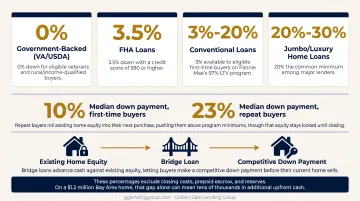
Real buyer behavior tells a different story than program minimums. NAR's 2025 Profile of Home Buyers and Sellers found the median down payment was 10% for first-time buyers and 23% for repeat buyers. Repeat buyers tend to roll existing home equity straight into their next purchase, which pushes their percentage well above program minimums.
That equity, however, is often locked in the home until closing. Bridge loans solve this timing problem by advancing cash against existing equity, letting buyers make a competitive down payment before their current home sells.
One important caveat: these percentages exclude closing costs, prepaid escrow, and reserves. On a $1.2 million Bay Area home, that gap alone can mean tens of thousands in additional upfront cash.
Low Down Payment Programs (0%-5%)
What's typically included: FHA, VA, and USDA minimums, plus mandatory mortgage insurance on most of these programs.
Best for: First-time buyers, eligible veterans, and buyers with limited savings who qualify on income and credit.
Standard Down Payment (10%-20%)
What's typically included: Conventional financing, with PMI required below the 20% threshold.
Best for: Move-up buyers with moderate home equity or savings who don't quite hit the 20% mark but want to avoid FHA's mortgage insurance rules.
Luxury/Jumbo Down Payment (20%-30%+)
What's typically included: Larger cash reserve requirements and stricter underwriting tied to bigger loan amounts.
Best for: Buyers targeting San Francisco's premium neighborhoods, where $1 million-plus purchases are the norm rather than the exception. Golden Gate Lending Group specializes in equity-based bridge loans that cover this exact gap.
Key Factors That Affect How Much Down Payment You Need
Your required amount comes down to three things: the loan program, the property itself, and your financial profile as a borrower.
Loan Program, Occupancy, and Property Type
FHA, VA, USDA, conventional, and jumbo loans each set their own minimums, and those minimums aren't negotiable at the program level. A VA-eligible buyer and a jumbo borrower financing the same $2 million home face entirely different cash requirements out of the gate.
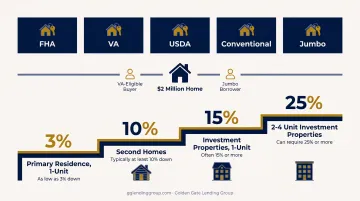
Occupancy adds another layer. Lenders treat occupancy types differently:
- Primary residence, 1-unit: as low as 3% down under standard conventional guidelines
- Second homes: typically require at least 10% down
- Investment properties (1-unit): often require 15% or more
- 2-4 unit investment properties: can require 25% or more
Home Price, Credit Profile, and Cash Reserves
The same 20% looks very different depending on where you're buying. Twenty percent down on a $600,000 home is $120,000, while the same share on a $1.8 million San Francisco property comes to $360,000. Higher-cost markets like Marin County and San Francisco magnify the dollar impact of even small percentage differences.
Credit score and DTI compound this effect. A stronger credit score and lower DTI don't just help you qualify — they can unlock better pricing and lower down payment options. Fannie Mae's loan-level pricing adjustments vary directly by credit score band and loan-to-value ratio, meaning a thinner down payment paired with a weaker score can get expensive fast.
Buyers financing $1 million-plus properties often need to show reserves beyond the down payment. Wells Fargo's published jumbo guideline calls for at least 12 months of mortgage payments in reserve, on top of a down payment that's commonly 20% or more, according to Wells Fargo's jumbo loan program details. This reserve requirement catches a lot of otherwise well-qualified buyers off guard.
Can You Borrow Money for a Down Payment? Financing Options Explained
Yes, you can borrow money for a down payment, in several different ways. But each option comes with trade-offs that lenders will scrutinize during underwriting.
Home Equity Loan/HELOC
If you already own a home, a HELOC lets you tap existing equity to fund a down payment on the next one. It's revolving credit, usually at a variable rate, and payments can rise sharply once the draw period ends.
Gift Funds from Family
Gift funds aren't technically a loan, but they're one of the most common down payment sources. Lenders require a signed gift letter documenting the amount, the donor's relationship, and confirmation that repayment isn't expected, plus a clear paper trail showing the transfer.
401(k) Loan
You can typically borrow the lesser of $50,000 or 50% of your vested balance. Repayment usually runs on a five-year schedule, though that timeline can extend for a loan used to purchase a primary residence. Default triggers taxable income and a possible 10% penalty.
Bridge Loans for Move-Up and Luxury Buyers
This is where things get interesting for buyers who already own a home. A bridge loan lets you access the equity sitting in your current property to cover the down payment on your next purchase, before your existing home sells.
This is Golden Gate Lending Group's core specialty. Rather than waiting for a sale to close, owner-occupied bridge financing turns your existing equity into cash you can use right now. Loan amounts range from $1 million to $15 million across San Francisco's premier neighborhoods.
One client used this approach to beat out 20 competing offers with a 14-day, non-contingent close, a timeline no traditional financing could support.
Personal Loans
Generally discouraged. Personal loans raise your DTI, and most mortgage lenders view unsecured debt used for a down payment unfavorably. Fannie Mae's guidelines explicitly exclude personal unsecured loans as an acceptable down payment source.
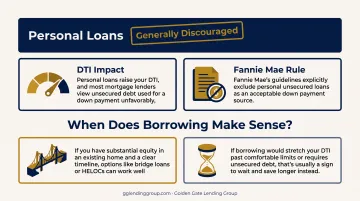
When does borrowing make sense? If you have substantial equity in an existing home and a clear timeline, options like bridge loans or HELOCs can work well. If borrowing would stretch your DTI past comfortable limits or requires unsecured debt, that's usually a sign to wait and save longer instead.
20% Down vs. Low Down Payment — What's the Difference?
The trade-off between a large down payment and a smaller one comes down to monthly cost versus speed to homeownership.
Monthly payment and interest rate: A larger down payment reduces your loan balance and monthly payment, and can help secure a better interest rate since you present less risk to the lender.
Private Mortgage Insurance (PMI): Conventional loans under 20% down require PMI, typically costing 0.36%-0.84% of the loan annually based on Freddie Mac's benchmark, depending on credit score and LTV.
FHA and USDA loans require mortgage insurance regardless of your down payment size, so putting more down won't eliminate it on those programs.
Speed to homeownership: Waiting years to save a full 20% carries its own cost. In a market where San Francisco County prices rose over 12% year over year, delaying a purchase to hit an arbitrary percentage can mean:
- Missing out on a specific home you love
- Facing a higher price tag by the time you're ready
- Paying more in rent while you wait
For many Bay Area buyers, a smaller down payment paired with PMI is the financially smarter move.
How to Estimate the Right Down Payment Budget for You
The "right" down payment balances three things: affordability, loan qualification, and long-term financial comfort. It's rarely just about hitting a round percentage.
Before you commit to a number, weigh these factors:
- Monthly payment comfort - What can you afford without stretching your budget thin?
- Post-closing reserves - Will you have cash left over for repairs, moving costs, or emergencies?
- Loan program eligibility - Does your down payment amount unlock or block certain programs?
- Financing timeline fit - Would a bridge loan or other financing tool help you move faster without depleting savings?
Weighing these factors upfront helps you sidestep the pitfalls that trip up most buyers.
Common mistakes to avoid:
- Draining every dollar of savings to hit 20% down
- Ignoring closing costs and reserve requirements until the last minute
- Assuming a purchase is out of reach without exploring financing alternatives first
For high-value or time-sensitive purchases in San Francisco, Marin County, or Silicon Valley, talk through your specific numbers with Golden Gate Lending Group's team before assuming what you can or can't afford.
Frequently Asked Questions
Can I borrow money for a down payment?
Yes. Options include HELOCs, gift funds, 401(k) loans, and bridge loans, which Golden Gate Lending Group specializes in for buy-before-sell financing. Each option carries different trade-offs that lenders evaluate carefully during underwriting.
How much would a $20,000 loan cost per month?
At current average personal loan rates, expect roughly $449/month on a 5-year term or $668/month on a 3-year term. Your exact payment depends on your rate, term length, and loan type.
What should you not tell a lender?
Never omit large deposits, undisclosed debts, or job changes. Lenders require full transparency, and inconsistencies discovered later can delay or derail your approval entirely.
What is the minimum down payment required to buy a house?
VA and USDA loans allow 0% down for eligible borrowers, FHA requires 3.5%, and conventional loans start around 3% for qualifying first-time buyers.
Do you need 20% down to avoid PMI?
Yes, on conventional loans, 20% down generally avoids PMI. FHA and USDA loans require mortgage insurance regardless of how much you put down.
Can gift funds be used as a down payment loan?
Gift funds are acceptable with a signed gift letter and documented transfer, but they can't be structured as something the buyer must repay. That would disqualify them as a gift.