Many buyers assume a mortgage is a mortgage. It isn't. Lenders view owner-occupied purchases as lower risk than investment properties, and they price accordingly.
That distinction gets more complicated in Bay Area markets, where jumbo loans, bridge financing, and multi-unit buildings are the norm rather than the exception. A single-family home in Pacific Heights or a two-unit building in Noe Valley can trigger very different underwriting depending on how you plan to use it.
This guide breaks down what separates owner-occupied and investment property loans, the financing tools available for each, and how to choose the right strategy for your next purchase.
Key Takeaways
- Owner-occupied properties qualify for lower rates and down payments as low as 3-5%
- Investment properties usually require 15-25% down, larger cash reserves, and DSCR-style loan products
- Misrepresenting occupancy intent to a lender is fraud, with real legal and financial consequences
- Bay Area buyers of luxury or multi-unit properties often need jumbo or bridge financing
- Golden Gate Lending Group structures equity-based bridge loans from $1M-$15M for owner-occupants buying before selling
What Is an Owner-Occupied Property vs. an Investment Property?
An owner-occupied property is one where the person on the title actually lives, using it as their primary residence. Standard mortgage agreements require moving in within 60 days of closing and staying at least 12 months, with limited exceptions for hardship or lender approval.
An investment property, by contrast, is purchased mainly to generate rental income or long-term appreciation. The owner doesn't live there. This single distinction shapes nearly every term of your loan, from your down payment to your interest rate.
House Hacking Still Counts as Owner-Occupied
San Francisco's multi-unit buildings create a popular gray area: an owner buys a duplex or triplex, lives in one unit, and rents out the rest. This is sometimes called "house hacking," and it still qualifies as owner-occupied financing, as long as the owner actually resides in one of the units within the required timeframe.
That means a buyer in Noe Valley or Bernal Heights can potentially access owner-occupied rates and lower down payments on a 2-4 unit property, even while collecting rent from tenants next door.
Why Lenders Draw This Line
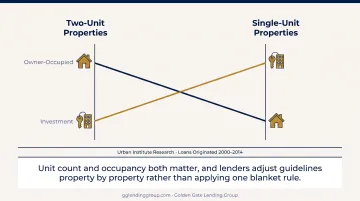
Lenders price risk, but the risk doesn't always break the way people assume. Urban Institute research on two-to-four-unit properties tracked default rates on loans originated between 2000 and 2014:
| Property Type | Owner-Occupied Default Rate | Investment Default Rate |
|---|---|---|
| Two-unit | 5.3% | 4.2% |
| One-unit | 3.2% | 2.9% |
For two-unit buildings, owner-occupied loans defaulted more often than investment loans. For single-unit properties, the pattern flipped.
The takeaway: unit count and occupancy both matter, and lenders adjust guidelines property by property rather than applying one blanket rule.
Occupancy Fraud: What Buyers Need to Know
Telling a lender you'll live somewhere when you actually plan to rent it out is fraud.
The Federal Housing Finance Agency defines occupancy fraud as falsely claiming intent to occupy a property to secure better loan terms. It's one of the more common forms of mortgage fraud because the incentive is obvious: owner-occupied loans come with lower rates and smaller down payments.
Consequences can include:
- Triggers loan acceleration or foreclosure if the lender discovers the misrepresentation
- Carries civil and criminal penalties, including fines and restitution
- Leads to prosecution and prison time in serious cases
- Forces the lender to demand loan repurchase or correction
If your plans change after closing, say, a job relocation forces you to rent out your new primary residence, talk to your lender. Circumstances beyond your control are typically treated differently than intentional misrepresentation from day one.
Key Differences Between Owner-Occupied and Investment Property Loans
The gap between these two loan types shows up in nearly every line of your term sheet.
Down Payment
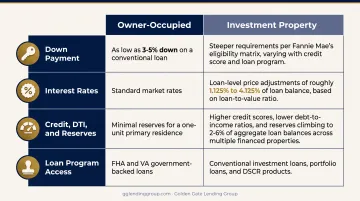
Owner-occupied buyers can put as little as 3-5% down on a conventional loan. Investment property buyers face a steeper bar:
| Property Type | Typical Minimum Down Payment |
|---|---|
| Owner-occupied, 1 unit | 3-5% |
| Owner-occupied, 2-4 units | 5% |
| Investment, 1 unit | 15% |
| Investment, 2-4 units | 25% |
These figures reflect Fannie Mae's current eligibility matrix, though exact requirements shift based on credit score, loan program, and whether the property qualifies for first-time buyer terms.
Interest Rates
Investment property loans generally carry higher rates than owner-occupied loans, reflecting the added default risk lenders absorb.
Rather than a flat rate premium, Fannie Mae applies loan-level price adjustments to investment purchases ranging from roughly 1.125% to 4.125% of the loan balance, depending on loan-to-value ratio. That adjustment gets baked into your quoted rate.
Credit, DTI, and Reserves
Investment property borrowers typically need:
- Higher credit scores than owner-occupied applicants
- Lower debt-to-income ratios, since lenders want more cushion
- Several months of cash reserves, versus minimal reserves for a one-unit primary residence
Own multiple financed properties already? Reserve requirements can climb to 2-6% of your aggregate loan balances across the portfolio.
Loan Program Access
Government-backed loans, FHA and VA, exist exclusively for owner-occupied purchases. Investors instead rely on conventional investment loans, portfolio loans, or DSCR products, covered next.
Financing Options for Owner-Occupied and Investment Properties
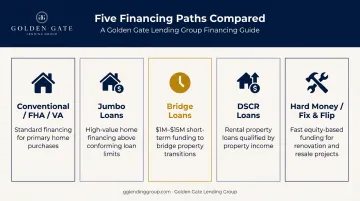
Conventional, FHA, and VA Loans for Primary Residences
Most owner-occupied buyers start here:
- Conventional loans — credit scores around 620+, down payments from 3-5%
- FHA loans — scores as low as 580 qualify for maximum financing with 3.5% down; scores between 500-579 require 10% down
- VA loans — available to eligible veterans and service members with no down payment requirement, though occupancy is mandatory
Jumbo Loans for High-Value Bay Area Homes
Conforming loan limits don't stretch far in San Francisco, Marin, San Mateo, or Santa Clara counties. All four hit the maximum conforming loan limit of $1,209,750 for a one-unit property in 2025. Anything above that number needs jumbo financing.
That describes most homes in Pacific Heights, Sea Cliff, and much of Marin County. Jumbo loans come with their own underwriting: larger reserves, tighter DTI thresholds, and often manual review rather than automated approval.
Bridge Loans: Buying Before You Sell
Here's a scenario that plays out constantly in competitive Bay Area markets: a homeowner finds their next house, but their current one hasn't sold yet. Waiting risks losing the property. A contingent offer risks losing negotiating leverage.
A bridge loan solves that timing problem. This is Golden Gate Lending Group's core specialty: owner-occupied bridge loans from $1 million to $15 million, built for California's luxury housing market.
Approval is based primarily on equity in the borrower's current home rather than income documentation. Qualified homeowners can move fast, often making a non-contingent, cash-competitive offer without waiting for a sale to close first.
DSCR and Portfolio Loans for Investors
Long-term rental investors often can't, or don't want to, qualify based on personal income, especially self-employed buyers or those with multiple properties already on their books.
DSCR loans (Debt-Service Coverage Ratio) address this by qualifying borrowers on the property's rental income relative to its debt payments, rather than tax returns or pay stubs. A DSCR above 1.0 generally means projected rent covers the mortgage payment.
Example: A Bay Area investor eyes a triplex generating $9,000 a month in combined rent. Instead of documenting personal income, a DSCR lender evaluates whether that rental income comfortably covers the proposed mortgage, taxes, and insurance. If it does, the loan can move forward largely on the property's own strength.
Investors who need short-term capital to acquire, renovate, or reposition a property before securing long-term rental financing can turn to hard money and fix & flip bridge loans to fill the gap. Golden Gate Lending Group offers exactly this kind of short-term, equity-based bridge financing, giving investors the flexibility to move quickly while permanent financing gets arranged separately.
Pros, Cons & Key Qualifying Considerations
The Owner-Occupied Trade-Off
Living in a property you also use as an investment, like a multi-unit house hack, has real advantages:
- Easier financing with lower down payments and better rates
- Access to more loan programs, including FHA and VA
- Hands-on property management since you're already on-site
- Faster response to maintenance issues or tenant concerns
It comes with friction too:
- Reduced privacy from sharing a building with tenants
- Landlord duties folded into your daily life, including collecting rent from neighbors down the hall
- Added responsibility for repairs, disputes, and lease management alongside your own household
How Much Income Do You Actually Need?
Lenders calculate this through your debt-to-income ratio, comparing monthly debt payments (including the new mortgage) to gross monthly income. Requirements vary by loan type:
- Manually underwritten conventional loans: generally capped around 36%, extendable to 45% with strong credit and reserves
- Automated underwriting: can allow up to 50% in some cases
- Freddie Mac loans: generally ineligible above 45%
A rough estimate: take your projected monthly mortgage payment (principal, interest, taxes, insurance) and divide it by 0.36. That's a starting figure for the gross monthly income you'd typically need, assuming minimal other debt. A loan officer can refine that based on your actual credit profile.
Does Age Affect Approval?
No, and this trips up more borrowers than you'd expect, particularly retirees. The Equal Credit Opportunity Act prohibits lenders from denying a loan based solely on age. A 75-year-old applicant with sufficient income, assets, and a clear ability to repay is just as qualified as a 35-year-old with the same financial profile.
Lenders can look at whether income is likely to continue (pensions, Social Security, investment distributions), but they can't reject an application simply because of a birth date.
Why Bay Area Buyers and Investors Choose Golden Gate Lending Group
Golden Gate Lending Group was built around one specific problem: Bay Area homeowners who need to move fast without being trapped by traditional financing timelines.
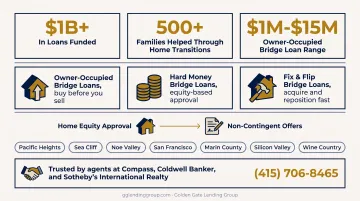
Founder Sofia Nadjibi, MBA, brings more than 25 years of mortgage lending experience to that problem. She structures owner-occupied bridge loans from $1 million to $15 million for clients across San Francisco, Marin County, Silicon Valley, and Wine Country.
Approval leans on home equity rather than income documentation, so clients can make non-contingent offers. That's a real advantage in neighborhoods like Pacific Heights, Sea Cliff, and Noe Valley, where competing against all-cash buyers is routine.
The firm also supports real estate investors navigating multi-unit properties across San Francisco's most sought-after neighborhoods. Short-term hard money and fix & flip bridge financing help clients acquire and reposition properties quickly.
That track record adds up:
- Over $1 billion in loans funded
- 500+ families helped through home transitions
- Trusted relationships with agents at Compass, Coldwell Banker, and Sotheby's International Realty
Weighing an owner-occupied purchase against an investment property? Or trying to buy your next home before your current one sells? Talk to someone who structures these deals daily. Contact Golden Gate Lending Group at (415) 706-8465 to discuss financing built around your specific situation.
Frequently Asked Questions
What is an owner-occupied mortgage?
An owner-occupied mortgage finances a property the borrower intends to use as their primary residence. Most loans require moving in within 60 days of closing and living there for at least 12 months.
How much income do I need to qualify for a mortgage?
It depends on the loan amount, interest rate, and your lender's debt-to-income limits, typically ranging from 36% to 50% of gross monthly income. A mortgage affordability calculator or a conversation with a loan officer will give you a personalized figure.
Can a 75-year-old get a 30-year mortgage?
Yes. Federal law under the Equal Credit Opportunity Act prohibits lenders from denying a loan based on age alone. Approval depends on income, assets, and ability to repay, not the borrower's birth date.
What is the 3-7-3 rule?
It refers to TRID mortgage disclosure timing. Lenders must provide a Loan Estimate within 3 business days of application, wait at least 7 business days before closing, and give borrowers 3 business days to review the final Closing Disclosure.
What's the difference between an owner-occupied and investment property loan?
Owner-occupied loans offer lower rates, smaller down payments, and access to programs like FHA and VA. Investment property loans carry higher rates, larger down payment requirements, and stronger reserve and credit standards.
Can I qualify for an investment property loan using rental income instead of personal income?
Yes. DSCR loans qualify borrowers based on a property's rental income relative to its debt obligations, rather than personal income documentation like tax returns or pay stubs.