

Introduction
You've cleared inspections, signed a mountain of paperwork, and packed your first box. Closing day feels like the finish line. Then your lender calls, or your agent texts something like "small hiccup" — and suddenly that finish line moves.
Delays happen more often than most buyers realize. Financing issues rank among the leading causes of delayed closings, according to ALTA's analysis of NAR survey data.
For San Francisco and Bay Area buyers, the stakes run higher. Rate locks, competing offers, and seven-figure price tags mean even a short delay carries real financial weight.
This guide covers why closings slip and what actually happens contractually and financially when they do. It also outlines the steps that protect your deposit and your deal, including how bridge financing can keep a purchase on schedule when timing goes sideways.
Key Takeaways
- Financing issues are the top cause of closing delays, but rarely a dealbreaker
- Most delayed closings still close successfully despite the setback
- Buyers risk earnest money, per diem fees, and expired rate locks, but retain contractual protections
- A responsive, experienced lender can mean a two-day delay instead of two weeks
- Bridge financing solves the timing gap between an unsold home and a new purchase
Common Reasons Your Closing Might Be Delayed
A closing involves your lender, the title company, your agent, the seller's agent, and often an escrow officer, all working on the same deadline. One weak link in that chain is usually enough to push back the date.
Financing and Underwriting Delays
Underwriters sometimes request additional documentation late in the process: an updated pay stub, a letter explaining a bank deposit, proof of funds for a large purchase. If your credit, income, or debt changes mid-process, your file can require re-underwriting from scratch.
Appraisals cause their own set of problems. When a home appraises below the sale price, lenders typically won't fund the full loan amount. Your options at that point:
- Renegotiate the sale price with the seller
- Bring additional cash to cover the gap
- Challenge the appraisal with comparable sales data
- Order a second appraisal (which adds more time)
Title and Legal Complications
Title searches surface problems that have nothing to do with you or the seller's honesty; they're often just paperwork from decades ago. Common issues include:
- Unresolved liens or judgments against a previous owner
- Missing heirs on an inherited property
- Divorce decrees that didn't properly transfer ownership
- Power-of-attorney documents that don't meet the title company's standards
ALTA's 2024 curative work study found that 36% of transactions require extensive, nonroutine title-clearance work, nearly double the effort of a standard file.
Property and Documentation Issues
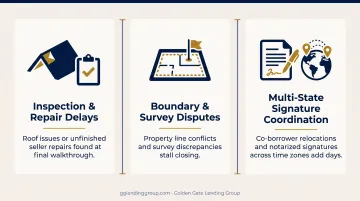
Last-minute inspection findings (a roof issue discovered during a final walkthrough, or a repair the seller promised but didn't finish) can stall closing. Boundary disputes and survey discrepancies do the same. So can logistics: if you have a co-borrower relocating for a job or signing from another state, coordinating notarized signatures across time zones adds days you didn't budget for.
What Happens When Your Closing Date Passes?
Missing your contractual closing date technically puts someone (buyer or seller) in breach of contract. What happens next depends almost entirely on your purchase agreement's specific language. Several consequences can follow, ranging from added costs to a lost deposit.
The per diem fee. Sellers often agree to extend closing, but they may charge a daily rate to cover their ongoing mortgage, property tax, and insurance costs while they wait. This amount isn't standardized under California law; it's negotiated and should always be documented in writing before you agree to it.
Your earnest money is at risk if you're found at fault. California's Civil Code section 1675 sets up a liquidated-damages framework for owner-occupied properties. If your deposit doesn't exceed 3% of the purchase price, the seller has an easier path to keeping it as damages if you default. This isn't automatic just because a date passed, though. It depends on:
- Whether active contingencies protected you
- Who actually caused the delay
- Whether proper notice and cure procedures were followed
Financing carries its own deadline pressure. Rate locks can expire. CFPB guidance notes that mortgage rate locks commonly run 30, 45, or 60 days, and extending a lock past that window can be expensive. If your closing slides past your lock period, you could face a materially higher rate on the same loan.
Not every consequence is severe. Credit impact is a longer-shot risk, not a given. A missed closing date alone doesn't hit your credit report. But if a dispute escalates into a legal judgment or unpaid debt in collections, that's a separate issue that could eventually surface on your credit history.
Steps to Take When Your Closing Is Delayed
If your closing date is in jeopardy, move fast and stay organized. Here's the order of operations:
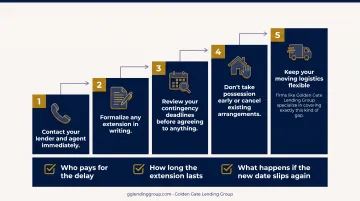
- Contact your lender and agent immediately. Ask for a written explanation of the delay's cause and a realistic revised timeline — not a vague 'should be soon.'
- Formalize any extension in writing. A signed extension addendum, shared with the title company and both agents, prevents confusion about the new deadline.
- Review your contingency deadlines before agreeing to anything. Confirm which party is responsible for the delay before you sign off on extension terms, since this determines who's exposed financially.
- Don't take possession early or cancel existing arrangements. Hold off on canceling renter's insurance, giving notice to your landlord, or moving belongings until closing is fully recorded.
- Keep your moving logistics flexible. Give movers, storage providers, and any temporary housing arrangement a heads-up that your date might shift.
If financing is the holdup, ask about bridge loan options; firms like Golden Gate Lending Group specialize in covering exactly this kind of gap.
Before signing any extension, do a quick gut-check. Make sure it clearly addresses:
- Who pays for the delay
- How long the extension lasts
- What happens if the new date slips again
If any of these are missing, ask your agent or a real estate attorney to clarify before you commit.
How Bridge Financing Can Keep Your Purchase on Track
Sometimes the delay traces back to the home you're selling, not your new purchase. Your buyer's financing falls through, their inspection drags on, or their own closing slips — and now your purchase is at risk even though nothing about it changed.
This is the exact timing mismatch that owner-occupied bridge financing is built to solve. Instead of waiting on your current home's sale to close or scrambling to satisfy a lender's re-underwriting request, a bridge loan taps the equity already sitting in your existing property. That equity funds your new purchase on schedule.
Golden Gate Lending Group specializes in this scenario for Bay Area homeowners. A few things that set the approach apart:
- Loans structured from $1 million to $15 million, sized for San Francisco's luxury neighborhoods and the broader Bay Area market
- Equity-based approval, rather than the income-heavy underwriting that trips up self-employed buyers, recently retired clients, or anyone with variable income
- A track record built on over $1 billion in funded loans, under founder Sofia Nadjibi's 25-plus years in mortgage lending
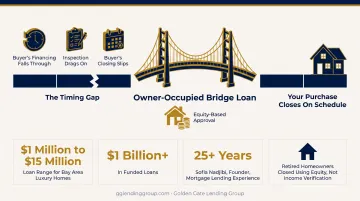
Consider a retired couple whose declining post-retirement income disqualified them from a conventional loan, even with substantial equity in their current home. A bridge loan solved it: they closed on their next property without waiting on traditional income verification, using the equity they'd already built instead.
Of course, bridge financing won't fix a bad appraisal or an unresolved title lien. But when the holdup is a timing gap between your sale and your purchase, it removes that gap entirely.
How to Minimize the Risk of a Delayed Closing
You can't eliminate every risk, but you can stack the odds in your favor.
- Order a preliminary title report early. As soon as the property is under contract, get this moving. It surfaces liens, judgments, or ownership issues while there's still time to resolve them.
- Avoid financial changes during underwriting. Don't open new credit cards, change jobs, or make large purchases while your loan is in process; any of these can trigger re-underwriting and reset your timeline.
- Choose a lender who moves fast and communicates proactively. The single biggest factor in avoiding (or quickly resolving) a delay is working with a team that responds to documentation requests the same day, not the same week.
An experienced, responsive lending partner catches problems before they become deadline emergencies. That's worth more than almost anything else in the closing process.
Frequently Asked Questions
Can a buyer back out if the closing is delayed?
Not usually, unless your contract's contingencies or timelines specifically allow it. Backing out without contractual cause risks forfeiting your earnest money deposit.
Is it normal for a closing to be delayed?
Yes. Delays are a routine part of real estate transactions given how many parties are involved, and most delayed closings still complete successfully.
Can you sue a lender for delaying the closing?
Rarely. Lender-caused delays are usually resolved through negotiation or contract remedies rather than lawsuits, though negligence or broken commitments may create limited recourse.
What is the 3-day rule for closing?
Under TRID requirements, buyers must receive their final Closing Disclosure at least three business days before closing. Certain changes, like an inaccurate APR, restart that waiting period and push back the date.
How long can a closing be delayed?
Anywhere from a single day to several weeks. Documentation gaps often resolve quickly, while title or legal issues typically take longer to clear.
Who pays for a delayed closing?
Whichever party caused the delay is generally expected to cover related costs, such as per diem fees, but this depends entirely on your specific purchase agreement's terms.