

Financing a second home isn't the same process as financing the house you already live in. Expect stricter underwriting, a bigger down payment, and loan structures you may never have needed before.
This guide walks through the exact steps, the 2026 qualification numbers, your financing options (including bridge loans), and the mistakes that trip up otherwise qualified buyers.
Key Takeaways
- Second-home mortgages demand higher credit scores, larger down payments, and tighter DTI limits than primary-residence loans
- FHA, VA, and USDA loans are off the table entirely — second homes require conventional, jumbo, home equity, or bridge financing
- Your ideal financing strategy depends on your home sale status, equity position, and how you'll use the new property
- Buyers who haven't sold yet often close faster with an experienced bridge lender than by waiting on a sale contingency
How to Buy a Second Home With a Mortgage in 2026
Step 1: Assess Your Finances and Define the Purpose of the Home
Before you tour a single property, get specific about what you're buying. A vacation home you'll visit six weeks a year has different loan implications than a place you plan to retire into within five years. Occupancy requirements and lender expectations shift based on intended use.
Next, run the real numbers. Add up:
- Projected mortgage payment on the second property
- Property taxes and homeowners insurance
- HOA or association dues
- Your existing primary mortgage and carrying costs
Loop in a tax advisor early. Mortgage interest deduction rules apply across your combined primary and second-home debt, not per property, and carrying two mortgages changes your overall tax picture more than most buyers expect.
Step 2: Get Pre-Approved and Compare 2026 Loan Options
Pre-approval matters more here than it did for your first home. Second-home underwriting digs deeper: lenders review your credit history, income, existing mortgage balance, asset reserves, and how the new payment stacks against what you're already carrying.
Before you shop, know your loan category. FHFA set the 2026 conforming loan limit at $832,750 for a one-unit property, with a high-cost ceiling of $1,249,125 in the most expensive counties.
Anything above your county's limit falls into jumbo territory, which comes with its own credit and reserve requirements.
Step 3: Find the Right Property and Make a Competitive Offer
A local agent who actually works second-home and vacation markets earns their commission here. They'll flag rental restrictions, zoning quirks, HOA rules, or short-term rental caps that could complicate financing before you fall in love with a listing.
Don't anchor on asking price. Pull comparable sales, particularly in coastal or resort markets where pricing swings hard between seasons.
In fast-moving luxury markets, a pre-approval letter, or proof of funds from a California bridge lender like Golden Gate Lending Group, can be the difference between winning and losing a bidding war.
Step 4: Complete Underwriting, Appraisal, and Closing
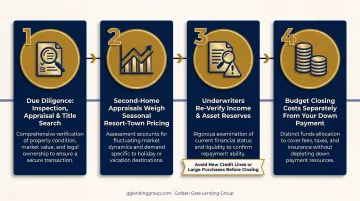
Once you're under contract, expect the usual due diligence: inspection, appraisal, and title search. Second-home appraisals sometimes weigh location and seasonal market activity differently than a primary-residence appraisal would, particularly in resort towns with volatile off-season pricing.
Underwriters will re-verify your income and asset reserves right before closing. Avoid opening new credit lines or making large purchases during this window — it's a common reason closings get delayed.
Budget closing costs separately from your down payment. The structure mirrors a primary-residence purchase, but the total cash needed adds up fast.
What You Need to Qualify for a Second-Home Mortgage in 2026
Lenders treat second homes as higher-risk loans, so your preparation directly affects both approval odds and the rate you're offered.
Down Payment and Credit Score Requirements
Fannie Mae's current eligibility matrix allows up to 90% loan-to-value on a fixed-rate, one-unit second-home purchase — meaning a 10% down payment is possible at the agency level, though many lenders set higher overlays. Putting down 20% or more still helps you avoid PMI and typically unlocks better pricing.
Credit requirements shifted recently. As of November 2025, Fannie Mae's automated underwriting system no longer applies a universal minimum credit score; it uses a proprietary risk assessment instead. That said, most lenders still want to see strong credit, generally in the high 600s to low 700s, before extending second-home financing. There's no single magic number anymore; your full file matters more than one score.
Debt-to-Income Ratio and Cash Reserves
Lenders calculate DTI on a second home across both properties: your existing mortgage payment plus the new one, divided by your gross income. Fannie Mae's automated system allows up to 50% DTI in some cases, though manually underwritten loans typically cap around 36-45%.
Reserves matter just as much:
- Fannie Mae requires a minimum of two months of reserves for second-home transactions processed through automated underwriting
- Additional reserves are often required if you own other financed properties
- Reserves must cover payments beyond your down payment and closing costs; they can't be the same funds
Property and Occupancy Rules: Second Home vs. Investment Property
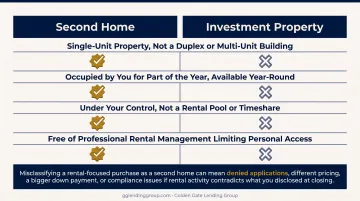
This distinction trips up more buyers than any other qualification issue. To count as a genuine second home under agency guidelines, the property must be:
- A single-unit property, not a duplex or multi-unit building
- Occupied by you for part of the year and available for your use year-round
- Under your control, not part of a rental pool or timeshare arrangement
- Free of professional rental management that limits your personal access
Misclassify a rental-focused purchase as a second home, and you risk more than a denied application. Lenders can require different pricing, a bigger down payment, or flag compliance issues down the road if rental activity contradicts what you disclosed at closing.
Best Ways to Finance a Second Home: Comparing Your 2026 Loan Options
There's no universal "best" loan here. The right choice depends on your equity position, your timeline, and whether your primary home has already sold.
Conventional and Jumbo Loans
Conventional loans remain the default path for most second-home buyers. Jumbo loans come into play once the purchase price exceeds your county's 2026 conforming limit. Jumbo underwriting also tends to be stricter across the board, with higher credit thresholds, larger reserve requirements, and bigger down payments than a standard conforming loan.
Home Equity Loans, HELOCs, and Cash-Out Refinancing
Tapping equity in your current home is a common way to fund a second-home down payment. The two main tools work differently:
| Option | Structure | Best for |
|---|---|---|
| Home equity loan | Lump sum, second lien on your primary home | Buyers who know the exact amount needed |
| HELOC | Revolving credit line, draw as needed | Buyers who want flexibility over time |
| Cash-out refinance | Replaces your entire first mortgage | Buyers whose current rate is higher than today's rate |
Cash-out refinancing only makes sense if today's rate genuinely beats what you're already paying. Otherwise, you're resetting a low-rate mortgage into a higher one just to access cash.
Bridge Loans for Buyers Who Haven't Sold Their Primary Home Yet
If your equity is locked up in a house you haven't sold, a bridge loan lets you access that equity now instead of waiting months for closing. It's a strategy that shows up constantly in competitive, high-value markets like San Francisco and Marin County, where a sale-contingent offer often loses to an all-cash or non-contingent buyer.
Golden Gate Lending Group specializes in exactly this scenario. The Corte Madera-based firm structures owner-occupied bridge loans from $1 million to $15 million, built around a client's home equity rather than income documentation alone.
Founder Sofia Nadjibi has spent more than 25 years in mortgage lending and has guided the firm to nearly $1 billion in funded loans, with working relationships built alongside agents at Compass, Coldwell Banker, and Sotheby's.

Bridge financing works best for buyers who:
- Have substantial equity built up in their current home
- Maintain a realistic, well-supported timeline for selling that property
- Need to move fast in a market where contingent offers get passed over
It's not the right tool for everyone. Bridge loans carry higher rates and fees than a standard mortgage, and they only make sense when the exit plan (selling the current home) is genuinely solid.
Common Mistakes to Avoid When Buying a Second Home
Even well-qualified buyers stumble on avoidable issues. Watch for these:
- Underestimating carrying costs. Insurance, utilities, maintenance, HOA dues, and seasonal upkeep add up fast beyond your mortgage payment, especially for coastal or mountain properties with harsher weather
- Assuming government-backed loans apply. FHA, VA, and USDA programs are designed for primary residences only, not vacation homes
- Hiding rental intentions from your lender. Disclose any plans to rent it out, even occasionally. Misrepresenting occupancy can complicate your loan and future refinancing
Conclusion
Buying a second home with a mortgage in 2026 is entirely doable, but it demands sharper preparation than your first purchase did. Stricter qualification standards, bigger down payments, and unique loan structures are simply a different set of rules to plan around.
Most financing delays trace back to the same culprits: underestimated reserves, miscalculated DTI, or a loan structure that didn't match the buyer's actual timeline. Get those three things right, and the rest tends to fall into place.
If you're eyeing a Bay Area second home and you're still sitting on equity in your current property, talk with a lender who specializes in that exact situation. Golden Gate Lending Group specializes in owner-occupied bridge financing for California's luxury market. Call the team at (415) 706-8465 to talk through your timeline and equity position.
Frequently Asked Questions
What is the best way to finance a second property?
It depends on your equity and timeline. Conventional or jumbo loans work well for most buyers, while those with strong equity in an unsold primary home often move faster with a bridge loan.
Do you have to put 20% down on a second property?
No. Some conventional programs allow as little as 10% down, though 20% avoids PMI and typically secures better pricing and terms.
Can a 50-year-old get a 25-year mortgage?
Yes. Federal law prohibits age-based credit discrimination, so lenders evaluate income, creditworthiness, and repayment ability instead of age when approving a loan term.
What credit score do you need to buy a second home in 2026?
There's no universal minimum anymore, but most lenders look for scores in the high 600s to low 700s for second-home financing, generally higher than what's expected for a primary residence.
Can you use a bridge loan to buy a second home before selling your first?
Yes, that's precisely what bridge loans are designed for. They let you access equity in your current home to fund a purchase before that property sells.
What's the difference between a second home and an investment property loan?
Second-home loans require personal occupancy for part of the year and prohibit professional rental management. Investment property loans are structured around rental income and typically carry different rates and larger down payment requirements.